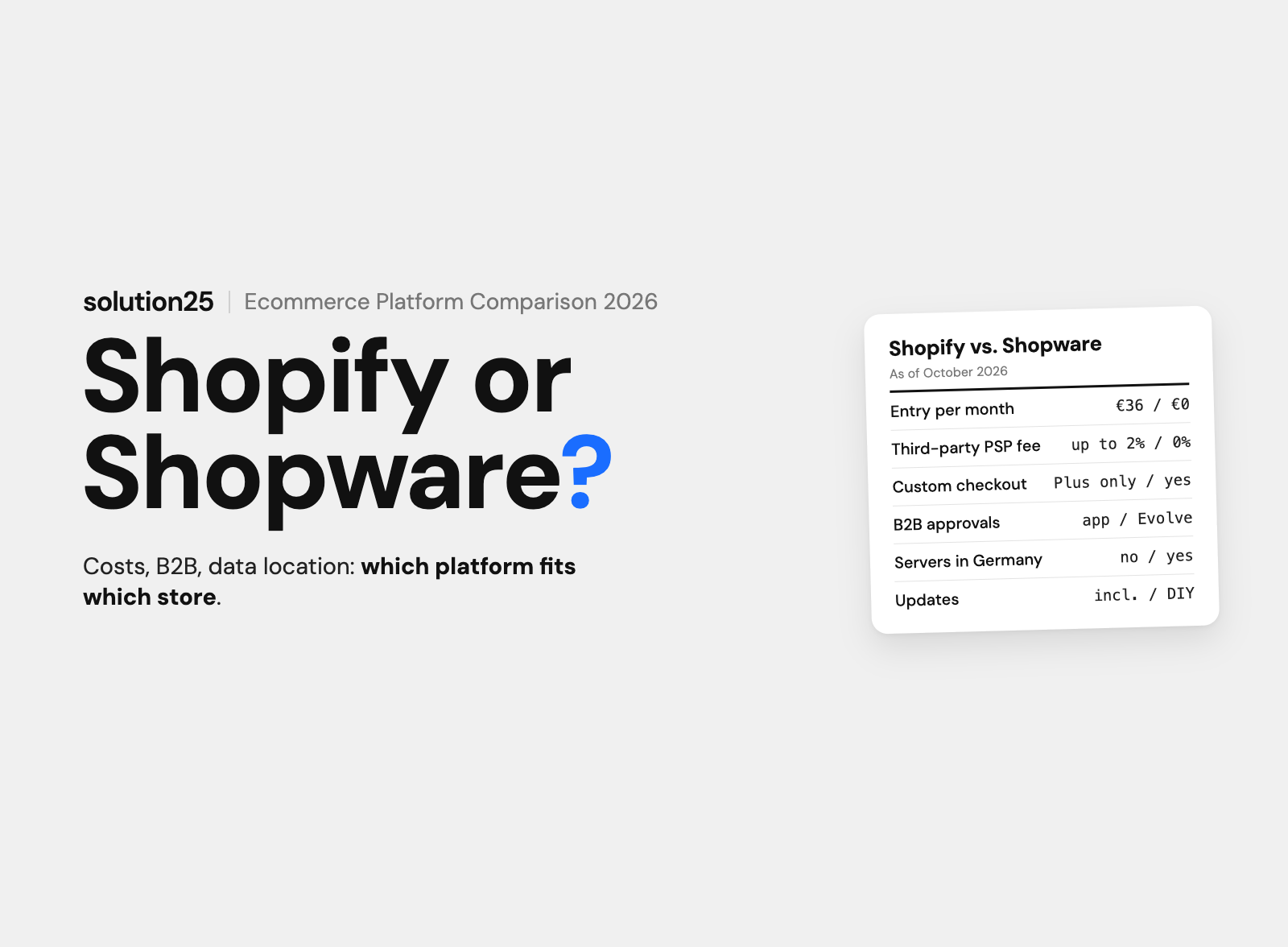

Shopify is faster and cheaper to get started with, while Shopware is more flexible and stronger in B2B. We implement both platforms and use official UK pricing and a worked example to show which one suits which shop.
Shopify is the faster platform and cheaper to get started with. Hosting, updates and security are included in the subscription, plans in the UK start at £25 a month, and a standard shop can be online in a few weeks.
Shopware is the more flexible platform for merchants with their own processes. The Community Edition has no licence fee, the code is open, there is no commission on orders through third-party payment providers, B2B features are part of the core, and you can choose your server location freely.
For mid-sized businesses, operations decide, not the list price. If you need to handle inventory management, custom pricing logic, B2B or several shops, Shopware is usually cheaper from the second year on. If you want to sell a manageable product range without your own IT team, Shopify is the right call.
At solution25, we implement both platforms: Shopware since our founding in 2017, now as a Platinum Partner, and Shopify for merchants whose requirements suit it. Before founding the agency, we built our own online shop and grew it to more than 500 orders a day, so we also know the platform question from the merchant’s perspective. Today we also support retailers in the UK.
Choosing between Shopify and Shopware determines for years what your shop costs and which processes it can handle. This article is for directors and e-commerce leads at mid-sized UK businesses who are facing a platform decision or considering a switch.
After reading it, you will be able to decide which platform suits your shop, using both vendors’ official prices, a worked example and a recommendation for each type of shop. Shopify prices are the UK list prices as of November 2026; Shopware bills its plans in euros (prices as of October 2026). All prices exclude VAT.
| Criterion | Shopify | Shopware 6 |
|---|---|---|
| Model | Subscription platform (SaaS), hosting included, closed source | Open source (Community Edition), self-hosting, PaaS or SaaS |
| Starting price | £25 a month (Basic), Plus from £1,800 a month | €0 (Community Edition), Rise from €600, Evolve from €2,400 a month (according to the provider) |
| Commission with third-party payment providers | 2% (Basic) to 0.2% (Plus) of revenue | None |
| Customisability | Theme and apps, checkout fully customisable only in Plus | Full access to code, data model and checkout |
| B2B | Company accounts, catalogues and payment terms in all plans, max. 3 catalogues below Plus; approvals and budgets only via apps | B2B Components from Evolve (quotes, approvals, budgets, roles), otherwise Store extensions |
| Hosting and data location | Google Cloud, storage in Europe for European merchants, processing also outside Europe | Free choice, for example hosting in the UK or in Germany; PaaS in Frankfurt |
| Extensions | More than 8,000 apps | More than 3,100 extensions in the Shopware Store |
| Updates and security | Handled by Shopify | Handled by your agency or your team |
| Good fit for | Quick launch, D2C brands (direct-to-consumer), manageable product range, selling without your own IT team | Custom processes, ERP integration, B2B, several shops, data sovereignty |
The pattern runs through the entire comparison: Shopify takes work off your hands and asks for standardisation in return. Shopware gives you control and asks for someone to be responsible for operations in return.
Shopify is a rented platform: you pay a monthly fee, and Shopify runs the servers, database, checkout and updates. You customise the theme in the editor or via the Liquid template language, and features come from the App Store. Anything Shopify does not provide can only be solved via apps or, in Shopify Plus, via checkout extensions; you cannot get at the core of the platform.
Shopware 6 is open-source software from Germany whose core is licensed under MIT. You decide where the system runs: with a hosting provider of your choice (self-hosting), in Shopware’s managed infrastructure (PaaS) or as a cloud version with automatic updates (SaaS).
Plugins reach deep into the system, from the pricing model to the checkout to integrations. This freedom has its price: hosting, updates and security are your job or your agency’s. Which operating model suits which shop size is covered on our page on Shopware hosting.
A Shopify shop can be run by a marketing team without developers. A Shopware shop needs someone on an ongoing basis who applies updates, reviews plugins and knows the server environment. This question decides whether Shopware’s flexibility is an advantage or a burden.
Shopify bills UK merchants in pounds sterling and shows the list prices for each location on its pricing page. The following amounts apply to merchants in the UK according to the provider; annual billing gives you a discount of around 25% on Basic, Grow and Advanced.
| Plan | Monthly | With annual billing | Online card fee (Shopify Payments, UK) | Commission without Shopify Payments | Additional staff accounts |
|---|---|---|---|---|---|
| Basic | £25 | £19 a month | 2% + 25p | 2% | None |
| Grow | £65 | £49 a month | 1.7% + 25p | 1% | 5 |
| Advanced | £344 | £259 a month | 1.5% + 25p | 0.6% | 15 |
| Plus | from £1,800 | 1- or 3-year term | 1.3% + 25p | 0.2% | Unlimited |
The card fees apply to standard domestic cards; international cards cost a surcharge. Shopify Plus is booked through sales; according to Shopify, larger merchants also pay a variable platform fee that depends on revenue.
On top of that come costs that do not appear on any pricing page: apps with their own monthly fees (typically £100 to £500 a month in our projects), a purchased or custom theme and, when selling in foreign currencies via Shopify Payments, for example in euros to EU customers, a currency conversion fee according to Shopify Help.
Shopware lists four plans on its pricing page and bills them in euros. The prices for Rise, Evolve and Beyond depend on gross merchandise value (GMV) and other factors; the amounts shown are starting prices according to the provider.
| Plan | Price | Includes, among other things | Support |
|---|---|---|---|
| Community Edition | €0 | Page builder, product and order management, Rule Builder, Flow Builder, multiple languages, currencies and sales channels | Community |
| Rise | from €600 a month | AI-assisted content creation, product personalisation, returns management | Direct support, 8-hour response time (Mon to Fri) |
| Evolve | from €2,400 a month | B2B Components (quotes, purchase approvals, roles, budgets), advanced search, content per customer group | Phone support, 4-hour response time (Mon to Fri) |
| Beyond | custom | Customer-specific pricing, inventory across multiple locations, Digital Sales Rooms (virtual consultation rooms) | 24/7 priority support, 1-hour response time |
The Community Edition is free, but bound by a fair usage policy: from €1 million GMV within 365 days, Shopware requires a switch to a paid plan. Rise can only be booked online for self-hosted shops, with a 30-day trial. We have broken down what hosting, implementation and maintenance add in our article on Shopware pricing.
Shopify charges a commission on every order that does not go through Shopify Payments: 2% on the Basic plan, 1% on Grow, 0.6% on Advanced and 0.2% on Plus. If you use a different provider as your main payment method, such as Stripe, Adyen or Worldpay, you pay this commission on top of that provider’s fees. PayPal alongside Shopify Payments is exempt.
Shopware does not charge any commission. You use PayPal, Klarna, Stripe, Adyen or another provider on that provider’s terms, nothing more. Shopware’s own payment solution, Shopware Payments, is currently only available to merchants based in Germany and Austria according to the pricing page, so it is not an option for UK shops at the moment. For UK merchants, Stripe, for example, charges 1.5% + 20p for standard UK cards according to the provider.
With £1.5 million in annual revenue through an external payment provider, that is £9,000 in commission a year on the Advanced plan, £15,000 on Grow, £30,000 on Basic and £3,000 on Plus. Except on Plus, that is more than the Shopware Rise licence costs at €7,200 a year.
The licence is rarely the biggest item on either platform. Based on our experience, implementing a Shopify shop with a customised theme costs £5,000 to £20,000, and with a custom theme, app setup and integrations £20,000 to £60,000. A Shopware shop starts at £10,000 to £30,000, and for mid-sized businesses with ERP integration and custom design it is £30,000 to £90,000.
In operations, the picture flips: Shopify handles hosting and updates, while with Shopware you can expect £50 to £500 a month for hosting and £400 to £2,500 a month for maintenance.
The calculation compares annual running costs for a UK B2C shop with £1.5 million in revenue and 30,000 orders on Shopify Advanced and on Shopware Rise with self-hosting and Stripe as the payment provider. These are rounded figures based on experience with a simplified payment mix (only standard UK cards), not quotes. Because Shopware bills its licence in euros, we show it separately and do not convert it.
| Item per year | Shopify Advanced | Shopware Rise (self-hosting) |
|---|---|---|
| Licence | £4,128 (£344 a month) | €7,200 (€600 a month) |
| Hosting | included | £3,000 (£250 a month) |
| Apps or extensions | £3,600 (£300 a month) | £3,600 (£300 a month) |
| Support, updates, customisations | £7,200 (£600 a month) | £12,000 (£1,000 a month) |
| Card fees with 100% card payments | £30,000 (1.5% + 25p) | £28,500 (Stripe, 1.5% + 20p) |
| Total | £44,928 | £47,100 plus €7,200 licence |
In this scenario, Shopify is cheaper by about £2,200 a year plus the Shopware licence, as long as the shop gets by with standard features. As soon as requirements come up that only Plus covers, such as a fully customisable checkout, more than three B2B catalogues or several shops, the Shopify licence rises to at least £21,600 a year, and Shopware Rise or Evolve becomes the cheaper option.
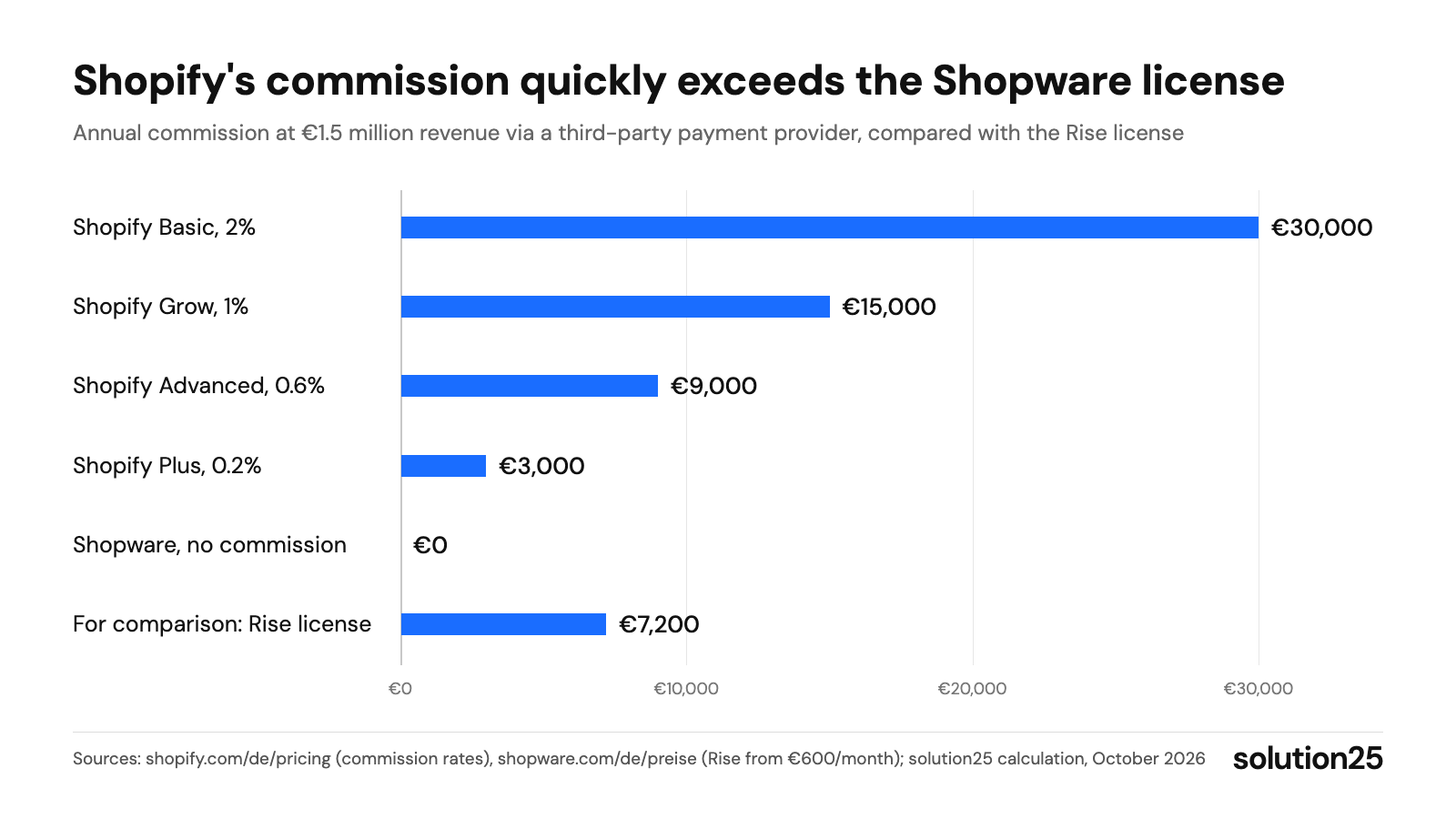
Figure: With high revenue through an external payment provider, the Shopify commission on Basic, Grow and Advanced exceeds the annual Shopware Rise licence. The chart is based on our calculation for the German market (Shopify and Shopware list prices in euros, as of October 2026); the UK figures above follow the same pattern.
Shopify themes are built on Liquid and the theme editor. Marketing teams can rework pages without developers, which for many merchants is the deciding advantage. You hit the limit when product data needs to be structured differently from how Shopify intends, for example with configurators or tiered pricing per customer group.
With Shopping Experiences, Shopware has its own page builder for categories, products and landing pages. The theme is based on Twig and the Bootstrap CSS framework and can be overridden in any file; any major change requires a developer who knows Shopware.
The Shopify checkout is one of the platform’s strongest arguments, because it is well maintained, fast and widely used thanks to Shop Pay, Shopify’s saved express checkout. In Basic, Grow and Advanced, it can only be customised to a limited extent; according to the pricing page, only Shopify Plus allows a fully customisable checkout.
In Shopware, the checkout is part of the software. Additional steps, required fields for business customers, pay by invoice with credit checks, delivery date selection or a custom design are plugin work, not a question of the plan.
Shopify has significantly expanded its B2B features in recent years. According to Shopify Help, company accounts with multiple locations, catalogues with their own prices, quantity rules, volume pricing, payment terms and stored credit cards are available in Basic, Grow and Advanced, with a maximum of three active catalogues.
Only Shopify Plus lifts the catalogue limit and adds direct assignment of catalogues to companies, deposits, partial payments and payment requests per delivery. What Shopify does not offer: multi-level purchase approvals, budgets per department and quote processes with negotiation. For that, you need apps or custom development via the API.
Shopware treats B2B as a core topic. Even the Community Edition supports customer groups, net prices, customer-specific pricing rules via the Rule Builder and pay by invoice for business customers. From Evolve, the B2B Components are added: quotes, purchase approvals, roles and permissions within the customer’s company, quick order, shopping lists, budgets and features for field sales.
If you shy away from the Evolve licence of at least €28,800 a year, the Shopware Store has extensions for quotes, approvals and price lists that are enough for many mid-sized B2B shops. Which option fits when is covered under Shopware B2B Components.
Our assessment: for a merchant serving business customers with their own prices and payment terms, Shopify is enough. For manufacturers and wholesalers with approval processes, budgets, quoting and ERP-driven pricing, Shopware is the better fit.
According to its own privacy documentation, Shopify runs its platform in several regions of Google Cloud Platform and distributes storage dynamically between them. For new merchants in Europe, shop, order and customer data are stored in Europe by default. For processing, Shopify still relies on international data transfers.
Legally, Shopify relies on contractual safeguards for these transfers; for the EU, these are the European Commission’s standard contractual clauses and the adequacy decision for Canada, and binding corporate rules (BCR) have been applied for. UK merchants should check with Shopify how transfers are covered under UK GDPR, for example through the UK Addendum or the IDTA. A guaranteed server location in the UK is not possible with Shopify.
With Shopware, you decide on the location: with self-hosting, the shop runs with a hosting provider of your choice, for example in a UK or German data centre. Transfers from the UK to the EU are permitted under UK GDPR because the UK recognises the EU as adequate. According to the Shopware documentation, Shopware PaaS Native runs on AWS in the eu-central-1 region in Frankfurt. For the SaaS version, Shopware speaks of hosting according to European standards; you clarify the specific location with sales.
Shopware 6 comes with a cookie consent manager, deletion of personal data in the admin and export of customer data. Shopware is certified to ISO/IEC 27001:2022, the international standard for information security. Responsibility for tracking tools and cookie consent under PECR, legal texts and data processing agreements remains with you on both platforms.
Shopify can be operated with a data processing agreement, appropriate transfer safeguards and a proper privacy policy; you assess the residual risk of international data transfers with your data protection lead, using the ICO’s guidance. If you serve sensitive customer groups, supply public sector clients or have to keep data in a specific location, there is no way around a self-hosted system like Shopware.
Shopify bundles international selling in Shopify Markets, which according to the pricing page is included in all plans: translated storefront, local domains, prices in local currencies (only with Shopify Payments) and tax and duty estimates. Since the UK left the EU, this matters for UK shops selling into Europe, where customs duties and import VAT apply. Multiple independent shops, on the other hand, are only available in Shopify Plus, with up to nine expansion stores that each need their own theme.
Shopware works with sales channels: multiple languages, currencies, domains and shops run in one installation with one admin, on every plan. Prices, taxes, payment methods and shipping methods can be controlled per channel and customer group, for example a UK shop in pounds with 20% VAT and an EU shop in euros. For merchants with several brands or country shops, that is a real advantage, including on costs: foreign currencies do not cost a surcharge, and a second shop does not need a second plan.
For TonerPartner, according to the project report one of the largest suppliers of printer supplies in Europe, we migrated 32 online brands with previously separate codebases onto a shared Shopware 6 system. Each brand keeps its own design, prices and content, while all of them share the business logic.
Many brands, shared logic and product data that does not fit a standard model: this combination clearly points to Shopware.
Connectors for common ERP systems such as Sage, Microsoft Dynamics or SAP Business One exist for both platforms. The difference lies in the edge cases: customer-specific price lists from the ERP, inventory per warehouse or order status from inventory management can be mapped directly in Shopware’s data model and checkout. With Shopify, such data has to fit into the standard model via metafields (extra fields for your own data), apps and the Admin API.
Then there are limits: Shopify tiers data access for custom apps and API rate limits by plan; according to the pricing page, Basic only gets limited data access, Advanced up to twice the limits, and Plus up to ten times the limits for selected APIs. With the Admin API, Store API, Sync API, webhooks (automatic notifications on events) and Flow Builder, Shopware sets no limits other than those of your server. How we plan ERP integrations is covered under ERP integration for Shopware 6.
Shopify applies updates itself, and twice a year the vendor bundles new features in the Shopify Editions. You do not have to do anything and cannot postpone anything. Apps and theme remain your responsibility.
Shopware regularly publishes patch releases and a new minor version about once a year; the current version is Shopware 6.7 (since June 2025), and according to endoflife.date, the previous version 6.6 receives security updates until February 2028. Every update needs a test on the staging environment (a non-public test copy of the shop), because theme and plugins can break. If you do not plan for this, you will be running a security risk after a year.
The most common reason for this switch in our projects: the shop has grown, and so have the number of apps and workarounds, and B2B or ERP processes can no longer be mapped cleanly. There is no Shopify profile in Shopware’s migration assistant; we pull products, categories, customers and order history via the Shopify API or CSV exports and import them into Shopware via the Admin API.
Customer passwords cannot be transferred from Shopify, so customers reset them on their first login; theme, apps and checkout customisations are rebuilt in Shopware. Expect 3 to 6 months and a budget similar to a new Shopware project. Our page on migrating from Shopify to Shopware 6 describes the process and the pitfalls.
This direction exists too, usually for merchants with a simple product range who want to get rid of the operational effort, or for Shopware 5 shops that have to start over anyway. Products and customers move to Shopify via CSV or API, and orders via apps or the Admin API. You will have to replace custom pricing logic, plugins and checkout customisations with apps or give them up, and you had better check that before switching.
| Shop type | Our recommendation | Reasoning |
|---|---|---|
| D2C brand, up to 500 products, standard processes, no IT team | Shopify (Basic or Grow) | Quick launch, low fixed costs, marketing team works independently |
| Merchant with inventory management, many variants, custom pricing logic | Shopware (Community Edition or Rise) | Customisable data model and checkout, no commission, ERP processes can be mapped |
| Manufacturer or wholesaler with approvals, budgets, quotes | Shopware (Evolve or B2B extensions) | B2B processes in the core, Shopify Plus only partially covers them |
| Merchant with business customers but simple B2B requirements | Shopify (Grow or Advanced) or Shopware | Company accounts, catalogues and payment terms are enough; decide based on team and data location |
| International D2C brand with many markets and high street retail | Shopify (Advanced or Plus) | Markets, checkout and POS from a single source, scaling without your own infrastructure |
| Several brands or country shops (for example UK and EU) from one back end | Shopware | Sales channels on every plan, with Shopify only from Plus |
| Companies with strict data location requirements | Shopware (self-hosting or PaaS) | Free choice of location, Shopify does not guarantee a specific server location |
Five questions that settle the decision in most projects:
Our take: We recommend Shopify when a marketing team is supposed to run the shop without developers and the product range fits the standard model. We recommend Shopware as soon as ERP-driven pricing, B2B processes, several brands or a data location requirement come into play, because with Shopify these requirements permanently cost more via Plus, apps and workarounds. When in doubt, the deciding question for us is who will be running the shop in three years.
Check these metrics quarterly, and weekly for the first eight weeks after a platform switch.
| KPI | Tool | Benchmark |
|---|---|---|
| Commission and payment fees | Shopify billing, payment provider reports | Annual commission below the Shopware Rise licence (€7,200 according to the provider), otherwise run the numbers on a plan change or platform comparison |
| App and plugin costs | Monthly bills | Typically £100 to £500 a month |
| Load time | PageSpeed Insights | LCP (load time) up to 2.5 seconds, INP (responsiveness) up to 200 milliseconds |
| Conversion rate | Google Analytics 4 | Stable or rising compared with the same period last year |
You should adjust course when new requirements can only be solved with additional apps or a plan change, or when running costs grow faster than revenue. The app costs are based on experience from our projects; the load time thresholds come from Google.
Neither platform is better across the board. Shopify goes live faster, is cheaper to start with and can be run without your own IT team. Shopware is more flexible, takes no commission on orders, is stronger in B2B and lets you choose your server location. What matters is your team, your processes and your planned revenue.
Pros: quick launch, hosting and updates included, an excellent checkout, a large app selection and Shopify Markets for international selling. Cons: commission of up to 2% with third-party payment providers, limited checkout below Plus, growing app costs, limited access to data and logic, and no guaranteed server location.
For UK merchants with their own processes, Shopware 6 is the most obvious alternative: open source, no commission, B2B features and free choice of hosting. For very small product ranges with lots of content, WooCommerce is an option, and for large enterprises Adobe Commerce. Which alternative fits depends on your product range, integrations and the team running the shop.
Usually not in the first year: implementing a Shopware shop costs more, and hosting and maintenance come on top. From the second year, the picture flips for merchants who would pay for Shopify Plus, many paid apps or the commission on third-party payment providers. With £1.5 million in revenue through an external provider, the Advanced plan alone costs £9,000 in commission.
Yes, in both directions. Products, customers and orders can be transferred via API or CSV, theme and extensions are rebuilt, and customers have to reset their passwords. Plan for 3 to 6 months and proper redirects for all old URLs, or your visibility on Google will suffer.
The IONOS online shop is a site builder for small shops with few products and standard requirements. Shopify offers significantly more features, apps and payment methods and grows with you. For merchants who run their shop as their main sales channel, Shopify is the better choice.
Send us your requirements and your payment mix via our contact page. We will compare both options with your numbers: implementation, running costs, payment fees and operational effort. Because we implement both platforms, our recommendation does not depend on which one we would rather sell. We work with merchants across the UK.
Already running a shop on Shopify or Shopware? Our free shop audit shows where you are leaving revenue on the table today, and whether that is down to the platform or the implementation. For conversion topics on both platforms, see our CRO services for Shopware and Shopify.
Besar Bilalli is co-founder and managing director of solution25, the Shopware agency based in Bremen. Before founding the agency in 2017, he and Besnik Bilalli built their own online shop without any start-up capital and grew it to more than 500 orders a day. Since then, he has guided merchants through Shopware projects, from platform selection to day-to-day operations. He is happy to answer questions about this article personally: get in touch.
Responsible for content and updates: Besar Bilalli. Last updated: November 2026. Next content review: February 2027.
