
AI agents search, compare and buy for customers. What OpenAI, Google, Stripe, PayPal, Shopify and Amazon have delivered through October 2026, what works in the UK, and how to prepare a Shopware shop.
Agentic commerce means an AI agent searches, compares, and buys on the customer’s behalf. The customer states a goal and a budget, and the agent handles everything up to the order, in ChatGPT, in Google Search, in Perplexity, or in the Amazon app.
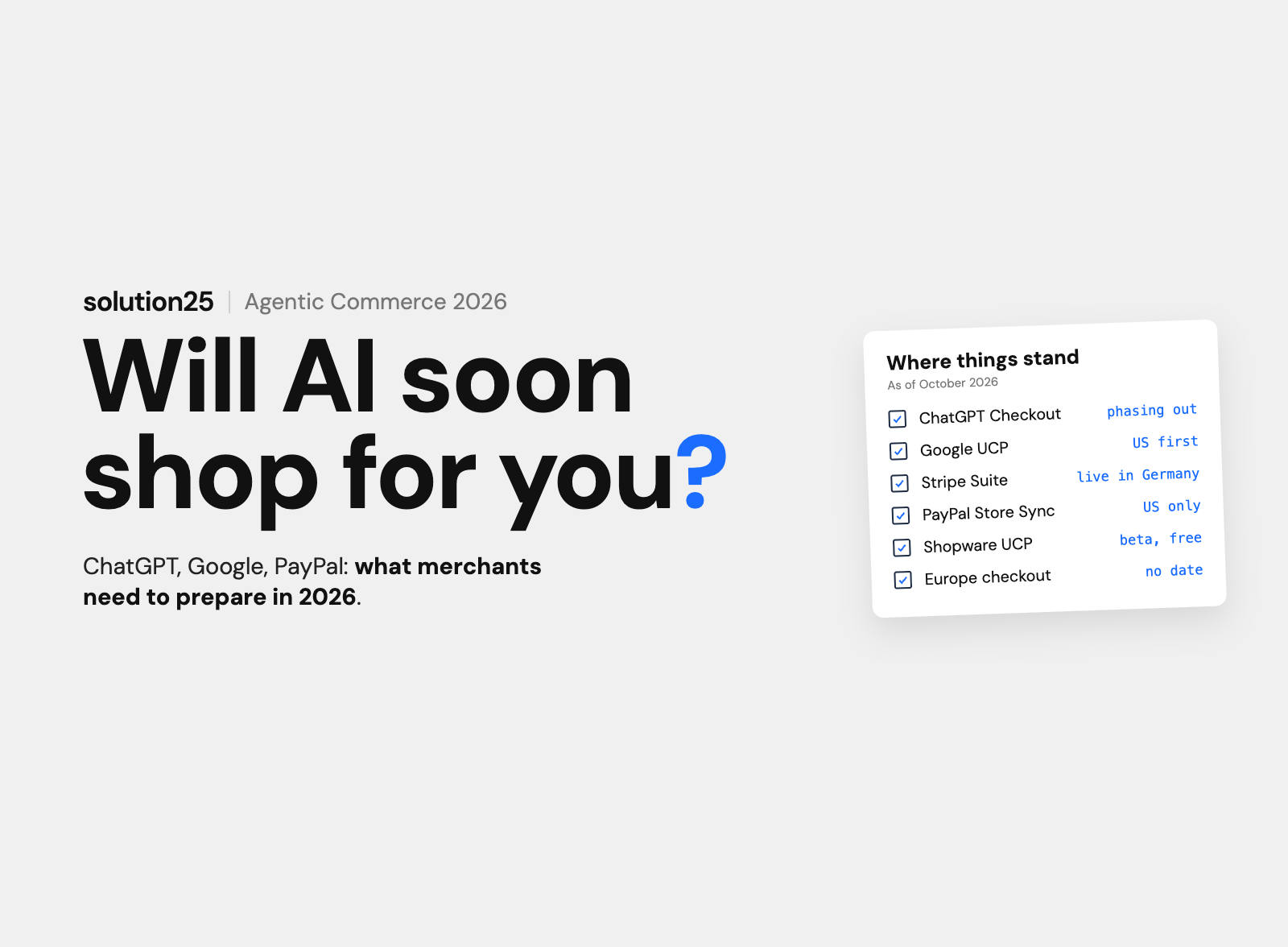
As of October 2026, buying directly in the chat is limited to the US. OpenAI scaled back its Instant Checkout after six months, while Google is rolling out checkout in AI Mode (the AI mode of Google Search) and in the Gemini app in the US and has announced Canada and Australia. There’s no date for Europe.
For UK merchants, visibility matters now, not checkout. Complete product data, feeds (product lists for the platforms), Schema.org markup in the page code, and a Store API (an interface with real-time prices and inventory) are your ticket in as soon as the programmes come to the UK.
Within a single year, OpenAI, Google, Stripe, and PayPal launched programmes in which AI agents preselect products, and stores with incomplete data get recommended less often there. This article is for UK shop owners and e-commerce leaders running their own Shopware store who need to decide when to invest in product data, feeds, and an agent channel.
After reading it, you’ll be able to judge which programmes UK merchants can access today, which eight building blocks your store needs, and in which order the effort pays off.
Before founding solution25, we built our own online store and grew it to more than 500 orders a day. We’ve been delivering Shopware projects since 2017, and since 2025 almost every client asks the same question: Can ChatGPT find our products, and what happens when a customer buys there? All prices as of October 2026, excl. VAT; our own experience-based figures are in pounds, third-party figures in their original currency.
Agentic commerce describes purchases in which a software agent acts for the customer. The customer delegates search, comparison, and ultimately the order to an AI system that talks to stores, payment providers, and delivery services via APIs. A chatbot describes a product; an agent puts it in the cart and pays.
Conversational commerce means the chat in your own store: a bot gives advice, and the customer clicks buy themselves. A shopping assistant like Amazon Rufus recommends products within a single platform. Agentic commerce goes further: the agent acts across platforms, and the merchant has to serve it as a channel.
The key difference: the agent is your customer. It decides based on data, not design, and drops out if the price or stock in the feed doesn’t match the checkout.
Within four months, OpenAI and Google each published a standard, plus there’s a payment protocol. All three are open source and keep the merchant as the merchant of record, in other words the customer’s contracting party.
| Protocol | Publisher | What it covers | Status October 2026 |
|---|---|---|---|
| Agentic Commerce Protocol (ACP) | OpenAI and Stripe, 29 September 2025, Apache 2.0 licence | Product feed, checkout sessions, delegated payment via token | Checkout part in ChatGPT is being phased out, feed part is the basis of product search; PayPal and Visa support ACP |
| Universal Commerce Protocol (UCP) | Google with Shopify, Etsy, Wayfair, Target, and Walmart, 11 January 2026 | Catalogue, cart, checkout, orders, account linking; transport via REST, MCP, or A2A | Checkout in AI Mode and Gemini for US merchants; Shopware provides a UCP extension (beta) |
| Agent Payments Protocol (AP2) | Google with more than 60 partners, 16 September 2025, with the FIDO Alliance since April 2026 | Signed mandates as proof of what the customer has authorised the agent to do | Version 0.2 allows purchases without the user present |
The Agentic Commerce Protocol consists of a product feed, a checkout API on the merchant’s system, and a specification for delegated payments. The merchant reviews the order, calculates taxes and shipping, and decides whether to accept it. Payment runs through a single-use token with a spending limit, which Stripe has implemented as the Shared Payment Token.
The Universal Commerce Protocol covers more than ACP: since 19 March 2026, it handles not only checkout but also the cart, real-time catalogue queries, and customer account linking. It builds on Google Merchant Center, and its supporters include Adyen, American Express, Mastercard, Stripe, Visa, and Zalando.
The Agent Payments Protocol answers the question of how the merchant and the bank can prove the customer actually wanted the purchase. The customer signs an Intent Mandate with a price limit, the agent creates a Cart Mandate with the specific cart, and that produces the proof of payment. Since 28 April 2026, AP2 has been with the FIDO Alliance, the industry body for authentication standards such as passkeys, and version 0.2 allows purchases without the user present.
OpenAI introduced Instant Checkout together with Stripe. US users could buy products from US sellers on Etsy in the chat, Shopify merchants were supposed to follow, and only single-item purchases were supported. According to OpenAI, merchants paid “a small fee,” but OpenAI didn’t disclose the amount.
The results were organic, ranked by availability, price, quality, and whether the merchant is the manufacturer or primary seller.
On 24 March 2026, OpenAI wrote that the first version of Instant Checkout didn’t offer “the flexibility” the company was aiming for. Since then, merchants have been using their own checkout, and OpenAI is focusing on product search. The OpenAI merchant page now states that standalone Instant Checkout is being phased out.
The partners themselves supplied the reasons: according to Wired, Walmart reported conversion rates in the chat three times lower than when users clicked through to the store, and Etsy told Modern Retail that sales were low. In January 2026, media had also reported a 4 percent fee for Shopify merchants, which OpenAI never confirmed.
The feed part of ACP is now the basis of product search in ChatGPT. Merchants provide a feed according to OpenAI’s feed specification and apply via the merchant page; Shopify merchants are connected via the Shopify Catalogue. The purchase is completed in the store, in the app via an embedded browser, with no fee to OpenAI.
Two restrictions remain: according to OpenAI, the merchant programme applies to users in the US, and the standard feed targets the US market with prices in US dollars. Large merchants such as Walmart and Sephora are building their own ChatGPT apps with account linking and payment instead.
Google isn’t building purchasing into a chat, but into Search, the Gemini app, and its own cart. The merchant remains the seller.
Since 13 November 2025, US users can set a price alert in Search and AI Mode with size, colour, and budget. If the price falls within range, Google buys the item after confirmation on the merchant’s site with Google Pay, at launch with Wayfair, Chewy, Quince, and selected Shopify stores.
With UCP, checkout came directly to AI Mode and the Gemini app on 11 January 2026, for eligible US merchants and with Google Pay. According to Google Help, the offer applies to signed-in users aged 18 and over in the US, and the merchant handles payment, shipping, returns, and service.
At Google I/O on 19 May 2026, the Universal Cart followed: a cart across all merchants, filled from Search, Gemini, YouTube, and Gmail, which tracks prices and pays via UCP with Google Pay. The rollout began in the US in summer 2026. On 16 September 2026, Google cited “hundreds of thousands of brands and merchants” with UCP checkout; according to Google, Canada and Australia will follow gradually through early 2027, and the UK later.
AI Mode has been available in the UK since July 2025, and products appear there from the Shopping Graph, which is fed by Merchant Center. Checkout in AI Mode, Gemini and Universal Cart isn’t enabled for UK shoppers yet; Google has said the UK will follow later but hasn’t given a date.
The new Merchant Center attributes for conversational search apply worldwide, and according to Google, merchants who implement Google’s feed recommendations see 5 percent more conversions the following month. Our article Google Shopping and Merchant Center with Shopware 6 shows how to connect your store.
Stripe launched the Agentic Commerce Suite on 11 December 2025. The merchant uploads a catalogue as a CSV, Stripe distributes it to connected agents, runs the checkout, processes the payment, and reports the order via webhook, an automatic message to the store system. According to the Stripe documentation, the suite is open to merchants in the US, Canada, and selected European countries, including Germany, Austria and Switzerland. UK merchants should check with Stripe whether their account is eligible.
The requirements show what agents depend on: update product data daily, inventory and prices every 15 minutes, and return policies as a required field. If you don’t want checkout in the agent, you mark products as discovery products that redirect to the store.
On 28 October 2025, PayPal announced support for ACP in ChatGPT and launched its Agentic Commerce Services. At their core is Store Sync: product data from PayPal merchants goes to AI platforms, and orders flow back into existing systems. Shopware is one of the four named partners, alongside Wix, Cymbio, and Commerce.
Store Sync is live in Perplexity (Instant Buy since 25 November 2025, US) and in Microsoft Copilot (Copilot Checkout since 8 January 2026); for ChatGPT and Gemini, PayPal said “soon” in January 2026.
Mastercard introduced Agent Pay in April 2025. According to Mastercard, all European card issuers have been enabled for it at the network level since June 2026, and banks such as Deutsche Bank, DZ Bank and N26 have completed controlled live transactions with agents. Santander, which reported Europe’s first complete agent payment in a regulated banking environment in March 2026, explicitly called it a test, not a commercial launch.
With the Trusted Agent Protocol from 14 October 2025, Visa starts one step earlier: agents identify themselves to the merchant with cryptographic signatures, so the store can tell them apart from malicious bots. Since April 2026, Visa Intelligent Commerce Connect bundles the connection to ACP, UCP, and this protocol in a single integration.
So agent tokens reach the store through the payment provider, not through the store system. We compare which providers fit Shopware in the article Shopware Payments, PayPal, Klarna, Mollie, and Stripe compared.
| Platform | What the agent can do | Availability October 2026 | Cost for merchants |
|---|---|---|---|
| ChatGPT (OpenAI) | Product search, shopping research, purchase in the store via embedded browser, merchant apps | Merchant programme for US users, feed in US dollars | No fee according to OpenAI |
| Google AI Mode, Gemini, Universal Cart | Product search, price alert with purchase, UCP checkout with Google Pay | Checkout US; AI Mode in the UK since July 2025 | No fee stated |
| Shopify Agentic Storefronts | Catalogue in ChatGPT, Copilot, AI Mode, and Gemini; direct checkout in Copilot and Google | Store must sell to the US; Agentic plan worldwide | No channel fee, only payment fees |
| Microsoft Copilot Checkout | Purchase in the chat with PayPal or card, catalogues via PayPal Store Sync and Shopify | US, since 8 January 2026 | No fee stated |
| Perplexity | Product search, Instant Buy with PayPal, Comet browser agent | Instant Buy US, merchants via PayPal Store Sync | No fee stated |
| Amazon Buy for Me, Shop Direct, Alexa for Shopping | Amazon agent buys on third-party brand sites, auto-buy at target price | US; feeds via feed management providers such as Feedonomics | No fee stated |
Shopify introduced its Agentic Storefronts in December 2025 and enabled the ChatGPT channel for millions of merchants on 24 March 2026. The purchase runs through the merchant’s Shopify checkout, and according to Shopify Help, the store has to sell to customers in the US.
Amazon takes the opposite approach: since April 2025 (beta), its own agent has been buying on third-party brand sites for US customers, and since 13 May 2026, Alexa for Shopping buys on its own once a target price is reached. Amazon doesn’t tolerate outside agents on its own platform, as the dispute with Perplexity over the Comet browser agent in November 2025 showed.
For the 2025 US holiday season, Adobe measured a 693 percent increase in traffic from generative AI services to retail sites, from a still small base. According to Adobe, AI visitors converted 31 percent better than other sources. Salesforce attributes 20 percent of worldwide online sales in the same season to AI and agents.
For Europe, McKinsey surveyed consumers in the UK, Germany and France in December 2025. 38 percent use AI to research products or make purchasing decisions, and according to McKinsey, trust drops significantly as soon as the agent is supposed to pay on its own. Today, decisions are prepared in AI answers, and the purchase happens in the store.
What still matters in classic search is covered in our article Shopware SEO.
Within reach for UK merchants are visibility in ChatGPT, AI Mode and Perplexity, Merchant Center and the Shopware extension for testing; the Stripe Agentic Commerce Suite depends on your account eligibility. Out of reach are purchasing in the chat, the ChatGPT merchant programme with sterling prices, and PayPal Store Sync. We describe how AI agents are changing retail as a whole in the article AI agents in ecommerce.
There’s no specific legislation for agent purchases in the UK. The following points summarise the general legal framework and don’t replace legal advice: have your terms and conditions, cancellation information and checkout reviewed by a solicitor before you launch an agent channel.
An AI agent has no legal personality, so it is generally not treated as an agent in the legal sense but as a tool, and the order is attributed to the user who set it up. How the courts will treat orders where the agent exceeds clear limits, such as a price limit, has not yet been tested. For merchants who also sell to consumers in Germany, the Händlerbund (as of October 2026) sets out the German position.
Consumers keep their 14-day right to cancel under the Consumer Contracts (Information, Cancellation and Additional Charges) Regulations 2013 even if an agent placed the order. In B2B, there’s no statutory right to cancel; what counts is the customer’s status, not the technology. If you also sell to consumers in the EU, note that since 19 June 2026 shops there have to offer a withdrawal button based on EU Directive 2023/2673, including for orders placed via an agent.
Regulation 14 of the same regulations requires the consumer to explicitly acknowledge the obligation to pay, with an order button labelled “order with obligation to pay” or equivalent unambiguous wording. How this applies when no human clicks and systems act via APIs is still unclear; the German discussion summarised by eRecht24 raises the same question. That’s why ACP and UCP require links to terms and return policies in the feed and an explicit purchase confirmation from the user in the agent.
Incorrect product data falls back on the merchant: if an incorrect price in the feed triggers an order, the merchant is liable as with any other misstatement. Errors in the agent infrastructure are the platform operator’s responsibility, and under the Consumer Rights Act 2015 a blanket exclusion of liability for “AI errors” is unlikely to be enforceable against consumers. UK GDPR and the Data Protection Act 2018 still apply unchanged, especially for payment data and profiling, with the ICO as the regulator.
At its Community Day on 10 June 2026, Shopware announced “UCP readiness” and full MCP coverage of the Commerce Core, and on 9 June 2026, it released the free Agentic Commerce (Beta) extension. It provides product feeds for OpenAI and Google Merchant Center as well as a UCP profile with catalogue, cart, checkout, and orders.
The extension requires Shopware 6.5.8 or newer; it’s currently at version 1.4.0 from 2 October 2026, and in beta. Reviews in the Store report bugs after updates, so it belongs on staging (a test copy of the store) first. According to Shopware, ChatGPT registration and PayPal Store Sync remain reserved for US merchants for now.
According to our case study, Miniature Market, a retailer of board games, miniatures, and hobby supplies, had problems with overselling when inventory information arrived late. During the move to Shopware 6, we connected the Deposco warehouse management system via an integration layer from Patchworks, with near-instant inventory updates and two-way order status sync.
A custom preorder plugin protects reserved quantities, and according to the case study, the integration eliminated the delays that had previously caused overselling. This project wasn’t about agents, but the requirement is the same: an agent orders whatever the feed and Store API report as available, and Stripe requires inventory and prices every 15 minutes.
| Building block | Shopware tools | Effort (from experience) |
|---|---|---|
| Product data audit and field maintenance | Properties, custom fields, import/export, PIM | 2 to 10 days; £2,000 to £10,000 |
| Merchant Center feed and shipping rules | Product comparison sales channel or feed extension | 1 to 3 days; £1,000 to £3,000 |
| Schema.org and agent access | Theme, robots.txt, hosting provider’s bot protection | 1 to 3 days; £1,000 to £3,000 |
| Store API review with load test | Store API, Rule Builder, cache | 2 to 5 days; £2,000 to £5,000 |
| UCP pilot on staging | Agentic Commerce (Beta), webhooks, payment provider | 3 to 8 days; £3,000 to £8,000 |
The ranges are based on experience from Shopware projects with feeds and integrations and aren’t quotes. You can read what a Shopware project costs overall under Shopware pricing. Shopware’s free Agentic Readiness Scanner gives you an initial assessment.

Figure: The chart shows the cost range per building block: if you start with product data and feeds, you first fund the part that already works in Google and ChatGPT today. Source: solution25 experience from Shopware projects with feeds and integrations, as of October 2026
| Timeframe | Action | Goal |
|---|---|---|
| Now through the end of 2026 | Product data audit, Merchant Center feed, Schema.org, agent access in robots.txt, readiness scan, AI referrers in tracking | Visible in ChatGPT, AI Mode, and Perplexity, channel measurable |
| First half of 2027 | UCP extension on staging, Store API load test, machine-readable return and shipping policies, review legal texts, choose payment provider | Technically ready as soon as Google or OpenAI open up the UK |
| Once enabled for the UK | Activate checkout in the UCP profile, pilot with part of the product range, measure contribution margin per channel | Agent channel as a calculated sales channel, not an experiment |
Our take: For most Shopware merchants in the UK, work on product data, feeds, and inventory sync pays off in 2026, but a dedicated agent checkout doesn’t yet. This work immediately benefits Google Shopping, AI Mode, and search in your own store, while purchasing in the chat has no date for the UK. We only plan a UCP pilot once the feed runs error-free and prices and inventory are consistently accurate.
| KPI | Tool | Benchmark | Cadence |
|---|---|---|---|
| Disapproved products | Diagnostics in Merchant Center | under 2% of the product range (from experience) | weekly |
| Freshness of price and inventory | Spot check of feed against product page | no discrepancies, sync every 15 minutes (Stripe requirement) | weekly |
| Mentions in AI answers | 20 to 30 fixed purchase queries in ChatGPT, AI Mode, and Perplexity | rising share compared to the baseline | monthly |
| Visits and revenue from AI services | Google Analytics 4, referral sources such as chatgpt.com | Conversion rate at least at the store average (from experience) | monthly |
The limits of measurement: purchases an agent completes via UCP or ACP don’t generate page views and only show up in the store’s order data. You should adjust course if disapproved products increase, Merchant Center reports price mismatches, or competitors show up in your test queries and your store doesn’t.
Agentic commerce refers to purchases in which an AI agent searches for, compares, and orders products on a customer’s behalf. The agent talks to the merchant’s systems via protocols such as ACP or UCP, and the merchant remains the customer’s contracting party.
“Agentic” describes AI systems that carry out multi-step tasks on their own instead of just answering questions: they plan, call APIs, and check the result.
Agentic marketing means marketing tasks that AI agents take over, as well as marketing aimed at agents as a target audience. For merchants, the second point is what counts, because agents read feeds and structured data instead of banners and landing pages.
Yes, revenue is shifting, not disappearing. McKinsey expects $3 to $5 trillion in sales via agents worldwide by 2030, and in ACP and UCP, the merchant remains the customer’s contracting party.
No. Instant Checkout was limited to US users and US merchants and, according to OpenAI, is being phased out. UK users see product results and are sent to the store to buy, and checkout in Google AI Mode and Gemini is also limited to the US.
As of October 2026, OpenAI, Google, Shopify, and Microsoft don’t charge a channel fee; only the usual payment fees apply. Based on our experience, preparing a Shopware store costs £9,000 to £29,000, depending on data quality and product range.
Running a Shopware shop in the UK and want to know whether ChatGPT, Google and Perplexity can find your products today and what’s missing for agent checkout? Get in touch: we’ll review the product data, Merchant Center feed, Schema.org, and Store API of your Shopware store and deliver a list of gaps per building block, with effort and priority.
Already running a store? Our free store audit shows where you’re leaving revenue on the table today, in search as well as in AI answers.
Learn more about how we work, our certifications, and our locations on the solution25 Shopware agency page.

Besnik Bilalli is founder and CEO of solution25, the Shopware agency based in Bremen. Before founding the agency in 2017, he built his own online store and grew it to more than 500 orders a day. Since then, he has guided merchants through Shopware projects, from the first cost estimate to day-to-day operations. He’s happy to answer questions about this article personally: get in touch.
Responsible for content and updates: Besnik Bilalli. Last updated: October 2026. Next content review: January 2027.
