The practical guide for Shopware: which questions customers ask ChatGPT, AI Mode, and Perplexity, how answer engines read your store, and which settings, copy, and data to adjust from Shopware 6.7.
Answer engine optimization (AEO) prepares your store to be cited by ChatGPT, Google AI Mode, and Perplexity and to have its products recommended. What counts isn’t your position in the results list, but whether a paragraph, a product property, or a feed record directly answers the customer’s question.
Shopware 6.7 provides most of the technology. Since 6.7.1, robots.txt (the file with rules for crawlers) can be maintained per domain, structured data as JSON-LD has been available since 6.7.9, and a product feed for OpenAI since 6.7.10.
Content and facts make the difference: answer paragraphs, FAQ blocks in Shopping Experiences (Shopware’s page layouts), well-maintained properties, genuine reviews, and machine-readable details on delivery time, returns, and manufacturer. In our experience, the technical foundation costs €2,000 to €8,000, and ongoing maintenance €800 to €3,000 a month.
Answer engines cite individual paragraphs and data records, and a store with marketing copy and incomplete properties gives them nothing worth citing. This article is for store owners and content managers running their own Shopware 6 store who want to prepare category and product pages for ChatGPT, AI Mode, and Perplexity.
After reading it, you’ll be able to define, for your most important categories, which customer questions get answered, where in Shopware the answer lives, and how to measure the impact.
Before founding solution25, we built our own online store and grew it to more than 500 orders a day. Since 2017, we’ve been delivering Shopware projects for merchants, from first stores to B2B systems with ERP integration.
How AI systems choose their sources in general is explained in our article on GEO optimization, and the technical settings from robots.txt to JSON-LD in the guide GEO for Shopware. This article is about content. All prices as of October 2026, excluding VAT.
Answer engine optimization covers everything that makes content appear as a direct answer in AI systems: in ChatGPT, Perplexity, Copilot, and Gemini, as well as in Google’s AI Overviews and AI Mode. Instead of ten links, an answer engine delivers a finished text or a product selection and names a few sources.
A sentence is citable if it can be lifted from the page and still be accurate without context. “Our backpack impresses with well-thought-out details” doesn’t work, but “The backpack holds 45 liters and weighs 1.4 kg” does: it answers a specific question and can be verified.
| Criterion | SEO | AEO | GEO |
|---|---|---|---|
| Key question | Does the page rank for the keyword? | Does the content answer the question directly? | Do AI systems mention the brand? |
| Result | Position in the results list, click | Citation, product card, recommendation | Mentions across all AI systems |
| Levers in the store | Technical setup, structure, links | Answer paragraphs, FAQ, structured data, feeds | Plus trade media and directories |
| Measurement | Search Console, rank tracker | Prompt tests, AI reports from Google and Bing | Monitoring tools |
The terms overlap and are often used interchangeably, along with ChatGPT SEO and the redundant “AEO optimization.” We draw the line like this: AEO works on the individual answer and its data, while GEO also works on how the brand is perceived across the web.
According to an Ahrefs study of 15,000 queries from August 2025, only around 12% of the URLs cited by AI assistants ranked in Google’s top 10 for the original query. For ChatGPT, it was 8%, for Perplexity 28.6%.
For AI Overviews, only about 38% of cited URLs came from the top 10 in March 2026, compared to 76% in July 2025 (Ahrefs, with an improved measurement method). Ahrefs suspects “query fan-out” as the reason: Google breaks a question down into several sub-queries and gathers sources for each (Google Search Central). A page that also answers the follow-up questions therefore has a better chance than one that only targets a single keyword.
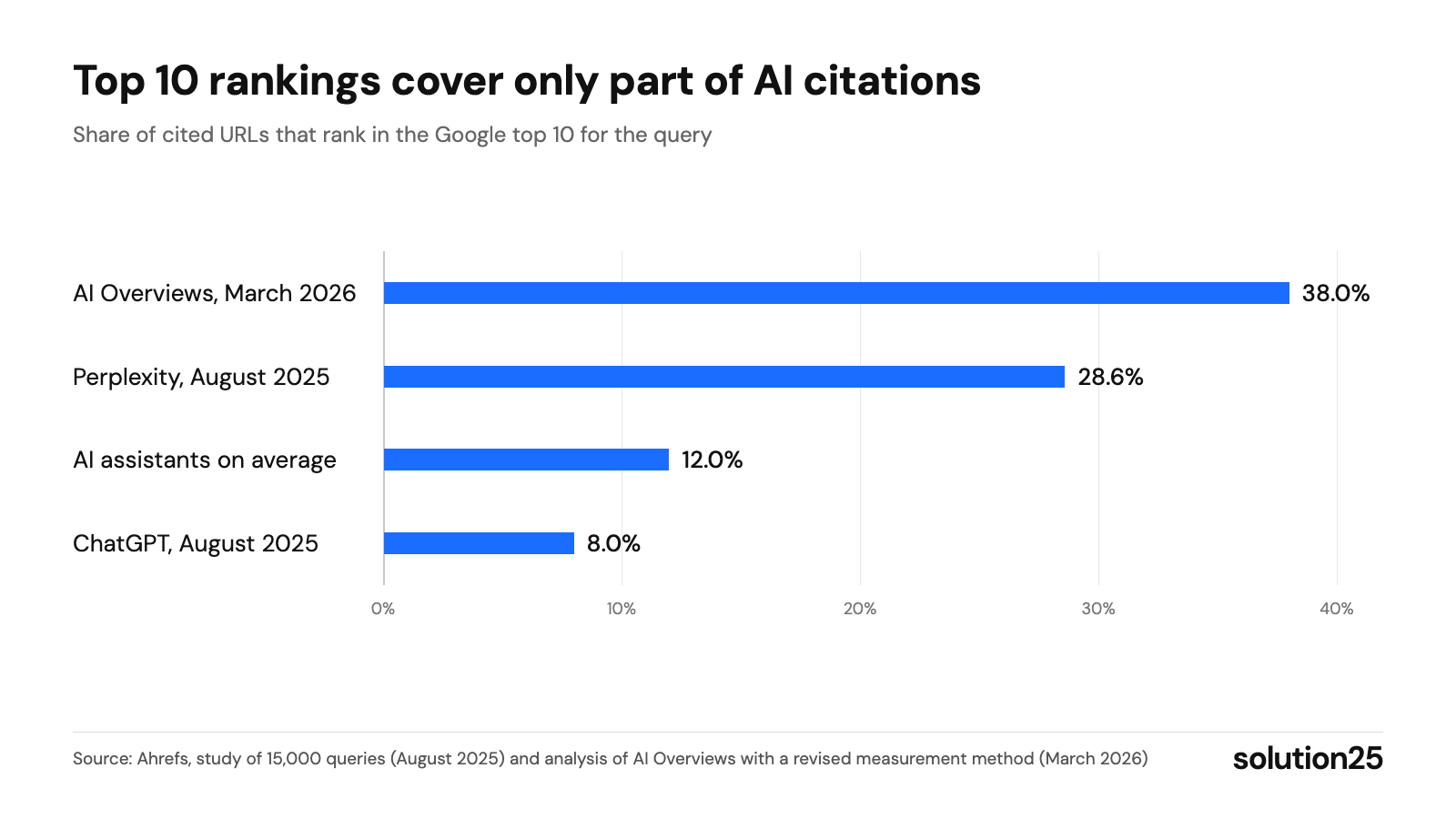
Figure: The chart shows that AI systems frequently cite pages outside the top 10: if you answer follow-up questions concretely, you can make it into the answer even without a top position. Source: Ahrefs, study of 15,000 queries (August 2025) and analysis of AI Overviews with a revised measurement method (March 2026)
52% of German consumers use AI when shopping online, up from 44% in September 2025. That’s the finding of Deloitte’s study “The State of Agentic Commerce in Europe” from May 2026, with 1,500 respondents in Germany. Users most often compare prices (32%) and products (24%) or have reviews summarized (22%).
For electronics and durable consumer goods, NIQ reports that 8% of consumers who research online before buying use AI search, 84% of them ChatGPT. They mainly compare models (55%), look for the best price (53%), or compare brands (38%).
This results in three types of questions: selection questions (“Which product is right for …?”), comparison questions (“A or B?”), and detail questions about properties, delivery, and returns. According to OpenAI, ChatGPT takes prices from structured product data, so they belong in your feed and JSON-LD.
The questions are examples, not measured data. The right column shows where the answer should live in the store.
| Industry | Sample question to the AI assistant | Where the answer lives in Shopware |
|---|---|---|
| Garden and home improvement | “Which cordless lawn mower can handle 400 m² with a slight slope?” | Category text with a selection rule, properties for area coverage and cutting width |
| Outdoor and sports | “Which hiking boots work for wide feet on multi-day hikes?” | Last width property, fit FAQ, reviews with sizing notes |
| Electronics | “Which robot vacuum can handle high-pile carpet and pet hair?” | Comparison table in the Shopping Experience, properties for suction power and carpet detection |
| B2B and spare parts | “Who supplies replacement seals for thermostatic valves to business customers on invoice?” | Compatibility as a property, FAQ on payment and shipping for business customers |
Answer engines use four access routes: crawlers for HTML pages, structured data, product feeds, and APIs for agents. Between 6.7.1 and 6.7.15, Shopware added features for each of them.
| Access route | What gets read | Where in Shopware | Available since |
|---|---|---|---|
| Crawlers (OAI-SearchBot, PerplexityBot, Googlebot) | Text, properties, reviews in the HTML | robots.txt per domain in the basic settings | 6.7.1, before that as a file |
| Sitemap | All indexable URLs | Settings, Sitemap section | Core feature |
| Structured data | Product, offer, reviews, shipping | Feature flag JSON_LD_DATA | 6.7.9, before that Microdata |
| Product feeds | Price, availability, GTIN, returns | Product comparison and Agentic Commerce sales channels | Agentic Commerce since 6.7.10 |
| Agentic files | /llms.txt, /AGENTS.md | Sales channel details | 6.7.12 |
| Store API with MCP server | Access for agents, catalog via extension | /store-api/_mcp | 6.7.11, experimental |
The standard storefront renders server-side, meaning it generates the HTML on the server (Shopware), and that matters: according to Vercel and MERJ, at the end of 2024 the crawlers from OpenAI, Anthropic, and Perplexity didn’t execute JavaScript. Anything a plugin loads via JavaScript, or that a headless frontend (one separated from the store system) only renders in the browser, stays invisible to them.
Since 6.7.9, Shopware outputs product, offer, reviews, and store data as JSON-LD, provided the feature flag JSON_LD_DATA (a switch for new features) is enabled. Google doesn’t require special markup for AI answers, but it recommends that structured data match the visible text: price, delivery time, and reviews in the answer paragraph have to match the JSON-LD; more on this under rich snippets in Shopware.
The prerequisite for any content work is crawler access, because according to OpenAI, if you block OAI-SearchBot, you won’t appear in ChatGPT’s search answers. Our guide GEO for Shopware describes the settings in detail: allow rules for feed landing pages and preview images, the sitemap, the MCP server as an interface for AI agents, and llms.txt, a content overview for AI systems whose effect on citations hasn’t been proven.
The technology opens the door, but it’s content that gets cited. We work in seven steps, starting with the 20 top-selling categories and their bestsellers:
The following sections show what copy and data look like in Shopware.
The first paragraph of the product description says what the product is, who it’s for, and where its limits are. Marketing sentences move further down.
A sample text without real product data: “The cordless mower covers up to 400 m² on a single charge, cuts a 37 cm swath, and weighs 15 kg. For slopes steeper than 20%, we recommend a self-propelled model.” Every statement can be cited on its own, and the stated limitation makes the recommendation credible.
The category copy starts with a decision rule, for example “For gardens up to 300 m², a cutting width of 32 to 34 cm is enough; from 500 m², 40 cm and two batteries make sense.” After that, it answers the follow-up questions: noise level, mulching function, compatible batteries.
Place the short answer paragraph as a text element above the listing, and the detailed text with a comparison table of the best-selling models below it. Both live in the category layout of the Shopping Experience and therefore in the delivered HTML.
Shopping Experiences let you create custom layouts for category and product pages. Five to eight genuine customer questions fit into a text element below the description or listing, each answer with two to four sentences and one concrete fact.
A collapsible accordion is fine as long as the text is in the HTML on page load. Since May 2026, FAQPage markup no longer produces rich results, meaning enhanced search results (Google), and Shopware’s JSON-LD doesn’t include it; if you want it, add it via the Twig templates, the theme’s template files.
Maintain dimensions, material, compatibility, and performance under Catalogues > Properties. Properties appear on the product page, serve as filters, and are the basis for variants (documentation).
Feeds read them too: in the Agentic Commerce channel, you map your properties to the OpenAI and Google fields, because Shopware doesn’t predefine color or size. From the Rise plan, the AI Copilot (Shopware’s AI assistant) suggests properties from the product description (Shopware AI); more on this under Shopware AI.
At the skincare brand Saltedbeauty, customers couldn’t filter products effectively. According to our case study, during the move to Shopware 6 we built filters for ingredients, applications, formulas, skin needs, and other attributes, and connected a chatbot recommendation that advises customers based on preferences, skincare routines, and product attributes.
The case study reports faster load times, longer sessions, and lower bounce rates afterward, but no numbers and no measurement in AI answers. For AEO, the case shows the lever: if you maintain attributes such as ingredient or skin need as properties, you answer selection questions like “Which serum is suitable for sensitive skin?” with data instead of marketing copy.
For selecting merchants, OpenAI cites availability, price, and quality, as well as whether the merchant is the manufacturer or primary seller. These facts have to match on the page, in the JSON-LD, and in the feed.
In Shopware, reviews only appear after approval under Catalogues > Reviews (documentation), and since 6.7.9 with average and count in the JSON-LD. They’re part of the answer: according to Deloitte, 22% of AI users have reviews summarized, and from Rise, the AI Copilot creates such a summary for the product page.
Since July 2026, Google’s guidelines for review snippets explicitly address fake reviews and reviews with undisclosed compensation (Google). Only collect genuine reviews after purchase.
You create delivery times under Settings > Delivery times with minimum, maximum, and unit, and assign them in the product (Shopware Hub). Maintain them per product, or the answer engine will quote “1 to 3 business days” for made-to-order items with a three-week lead time. In the OpenAI feed, an empty shipping cost field counts as unknown, not as free, according to the specification.
Shopware doesn’t come with a standard returns page, but the Agentic Commerce channel requires its URL for the OpenAI feed (documentation). Create a dedicated page with the return window, return shipping costs, and process, with an answer paragraph right at the top.
The release notes for the 6.7.9 JSON-LD don’t mention a return policy. For this, Google recommends MerchantReturnPolicy markup (a machine-readable return rule) on the organization (Google). Your agency adds this in the theme, and the same rule belongs in Merchant Center.
Under Catalogues > Manufacturers, you store logo, description, and website (guide). The OpenAI feed requires the brand as a mandatory field, and a GTIN (the global product number) must have 8, 12, 13, or 14 digits with a valid check digit and must not be made up. For private labels without a GTIN, brand and manufacturer part number handle the matching.
Answer engines respond in the language of the question, and Google AI Mode has also been available in German since October 2025 (onlinemarketing.de). In Shopware, each language gets its own domain or path in the sales channel, and hreflang (the language version markup in the page code) links the versions (documentation).
Besides descriptions, translate properties, FAQ blocks, delivery times, and the returns page. Reviews are tied to one language; from Rise, the AI Copilot translates them.
For AI Overviews and AI Mode, Google recommends up-to-date data in Merchant Center; in Shopware, this feed is created via the product comparison sales channel (guide for Shopware 6). 6.7.10 introduced the OpenAI feed as the experimental Agentic Commerce channel, and since 6.7.12 it has been moving into the free Agentic Commerce (Beta) extension, which is rated 1.4 out of 5 stars in the Shopware Store, with reports of crashes after updates.
That’s why we set up the channel on staging and switch it live as soon as OpenAI admits European merchants. Our article on agentic commerce describes which programs are available in Germany today.
The cheapest measurement is a fixed prompt set: one selection, one comparison, and one detail question from each of your ten most important categories, asked once a month in ChatGPT, Perplexity, Gemini, and AI Mode, without logging in. Note whether your store is mentioned, which URL is cited, and which competitors show up. The trend over three to six months is what’s meaningful.
Since August 31, 2026, Search Console has shown a performance report for generative AI worldwide (Google Help). It counts how often links to your website appeared in AI Overviews and AI Mode, by page, country, date, and device. Clicks and queries are still missing, and according to Google, the “Search generative AI” setting is set to “Include” by default.
Since February 2026, Bing Webmaster Tools has offered the AI Performance report as a public preview (Bing). It shows citations in Copilot and Bing’s AI summaries, the cited URLs, and the search phrases the AI used to retrieve your content. These grounding queries give you ideas for new FAQ entries.
Monitoring tools like Ahrefs Brand Radar, Otterly.ai, or Peec AI run prompts at scale; our GEO article compares prices. The free Agentic Readiness Scanner from Shopware rates product data, discoverability, and agent standards, but only checks a sample of pages. AI visits show up in GA4 as referral sources, and orders from the Agentic Commerce channel in its statistics.
The limits of measurement: Search Console doesn’t yet show clicks or queries, and AI answers fluctuate from day to day. If a category isn’t cited in any test question after three months, check the answer paragraph and properties first, then the feed and reviews.
| No. | Checkpoint | Where in Shopware | Done when |
|---|---|---|---|
| 1 | Crawler access | robots.txt, CDN, firewall | AI bots show up in the server logs |
| 2 | Rules for feeds and images | Update to 6.7.15 or allow rules | feed landing pages and preview images can be retrieved |
| 3 | JSON-LD | Flag JSON_LD_DATA from 6.7.9 | the Rich Results Test passes without errors and without duplicate markup |
| 4 | Google and Bing | Search Console, Bing Webmaster Tools | AI features are allowed and AI reports are set up |
| 5 | Answer paragraphs | Description, text element in the category layout | top 20 categories and bestsellers start with an answer |
| 6 | FAQ blocks | Text element in Shopping Experiences | five to eight genuine questions per category are in the HTML |
| 7 | Properties | Catalogues > Properties | comparison attributes aren’t only in running text |
| 8 | Facts | Reviews, delivery times, returns page, manufacturer | page, JSON-LD, and feed say the same thing |
| 9 | Product feeds | Product comparison, Agentic Commerce on staging | Merchant Center is error-free and the OpenAI feed is prepared |
| 10 | Measurement | Prompt set, Search Console, Bing, GA4 | baselines are documented and a monthly review is scheduled |
If you can only invest one day, take care of points 1, 3, and 4. They determine whether answer engines can read the store at all and whether later content work can be measured.
Our take: We don’t start AEO with files for AI crawlers, but with the 20 categories that generate the most revenue. In our experience, an answer paragraph, five genuine FAQs, and well-maintained properties on these pages achieve more than any single technical measure, provided crawler access and JSON-LD are in place.
The ranges are based on experience from our projects, not list prices. We calculate the audit (€1,500 to €4,000) and technical foundation (€2,000 to €8,000) as in our article on GEO optimization; the table shows the items that make the difference for AEO. What a Shopware project costs overall is covered in our article on Shopware pricing.
| Item | Range | Included |
|---|---|---|
| Product data | €2,000 to €10,000, one-time | Create and populate properties, check GTIN and manufacturer, delivery times per product |
| Answer paragraphs and FAQ | €150 to €400 per page | Research customer questions, answer paragraph, FAQ block, comparison table |
| Ongoing support | €800 to €3,000 a month | Prompt tests, Search Console and Bing analysis, content updates |
Two examples: a small store with an audit (€2,000), technical foundation (€3,000), and 20 category pages at €250 each comes to €10,000 in the first year. A mid-sized store with an audit (€3,500), technical foundation (€6,000), product data (€6,000), 60 pages at €300 each, and nine months of support at €1,000 each comes to €42,500.
AEO stands for answer engine optimization, the optimization of content for AI answer engines such as ChatGPT, Perplexity, Copilot, and Google AI Mode. The goal is to be cited as a source or recommended as a product. In customs law, by contrast, AEO stands for Authorized Economic Operator.
SEO works on your position in the results list and the click, while AEO works on whether a paragraph or data record gets used as the answer. The fundamentals overlap, but according to Ahrefs, only about 12% of the URLs cited by AI assistants rank in Google’s top 10.
Partly. According to Google, AI Overviews and AI Mode don’t require any special optimization, and SEO fundamentals still apply. What’s new is the focus: answers in the first sentences, facts in data and feeds, and measurement through citations.
Check crawler access, enable JSON-LD from 6.7.9, write answer paragraphs and FAQ blocks for your most important categories, then maintain properties, reviews, delivery times, returns, and feeds. Measure with prompt tests and the AI reports from Google and Bing.
To get started, a manual prompt set, Search Console, and Bing Webmaster Tools are enough. For many prompts over several months, there’s Ahrefs Brand Radar, Otterly.ai, or Peec AI, although according to Google, no third party has access to its internal AI systems.
The 20 top-selling categories and their bestsellers, and among those, first the ones where competitors are named in prompt tests. Next come product pages with lots of customer service questions, because the answers there can be derived directly from existing inquiries.
According to their own documentation, OpenAI and Perplexity pick up changes to robots.txt within up to 24 hours. New copy only takes effect after the next crawl; in our experience, the effect shows up in prompt tests after two to eight weeks.
Want to know whether ChatGPT, Perplexity, and AI Mode can read your store and which categories work as answers? Get in touch: we’ll check crawler access, JSON-LD, and product data, ask 30 customer questions in four systems, and name the measures with the biggest impact.
Already running a Shopware store? Our free store audit shows where indexing, structured data, and product data are costing you visibility today, on Google and in AI answers.
Learn more about how we work, our certifications, and our locations on the solution25 Shopware agency page.
Besar Bilalli is co-founder and Co-CEO of solution25, the Shopware agency based in Bremen. Before founding the agency in 2017, he and Besnik Bilalli built their own online store without any startup capital and grew it to more than 500 orders a day. Since then, he has guided merchants through Shopware projects, from platform selection to day-to-day operations. He’s happy to answer questions about this article personally: get in touch.
Responsible for content and updates: Besar Bilalli. Last updated: October 2026. Next content review: January 2027.
