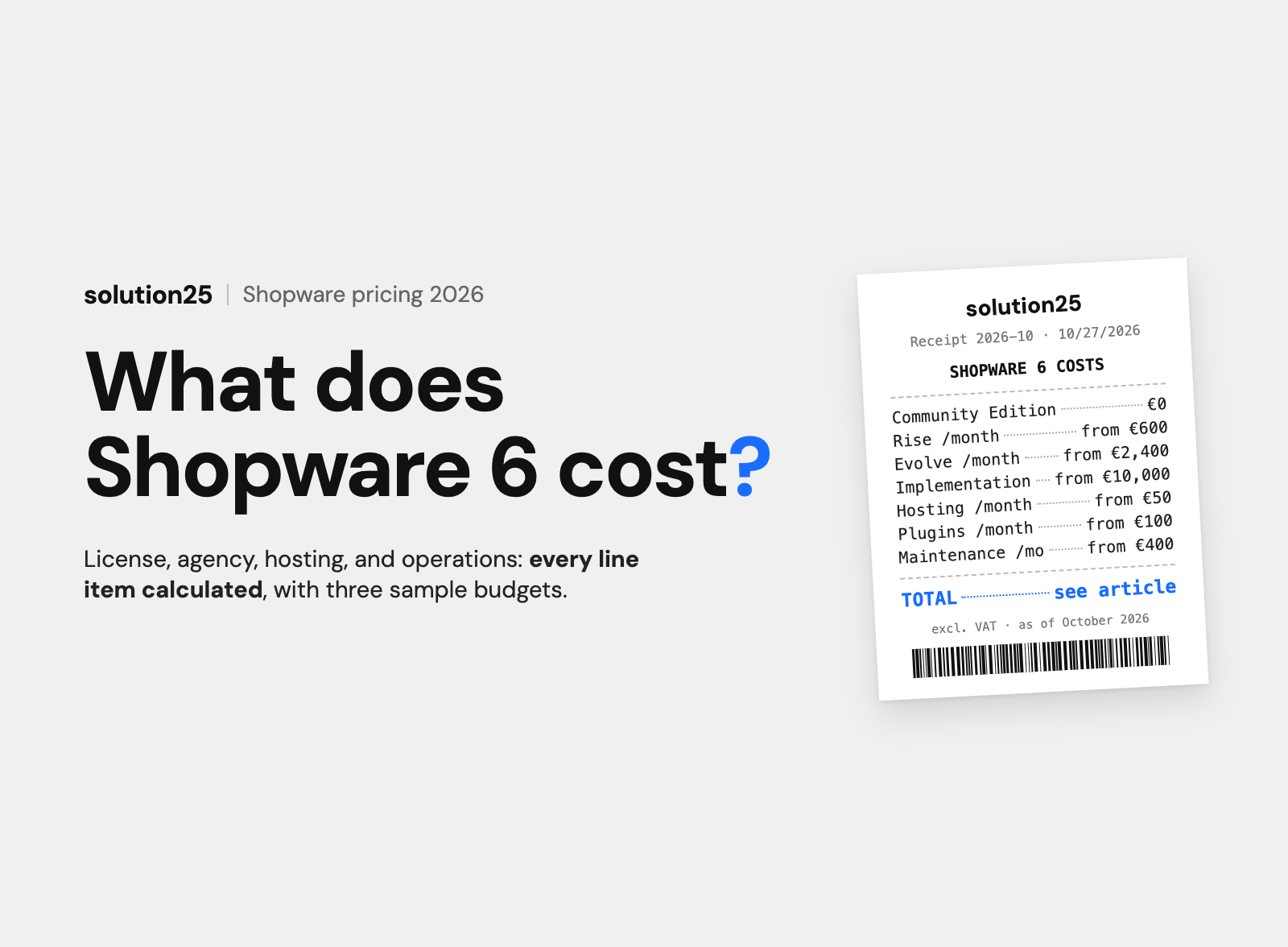

The Shopware 6 Community Edition has no license fee, Rise starts at €600 and Evolve at €2,400 per month. But the license is the smallest line item: what implementation, hosting, extensions, and operations really cost, with three sample budgets. As of October 2026.
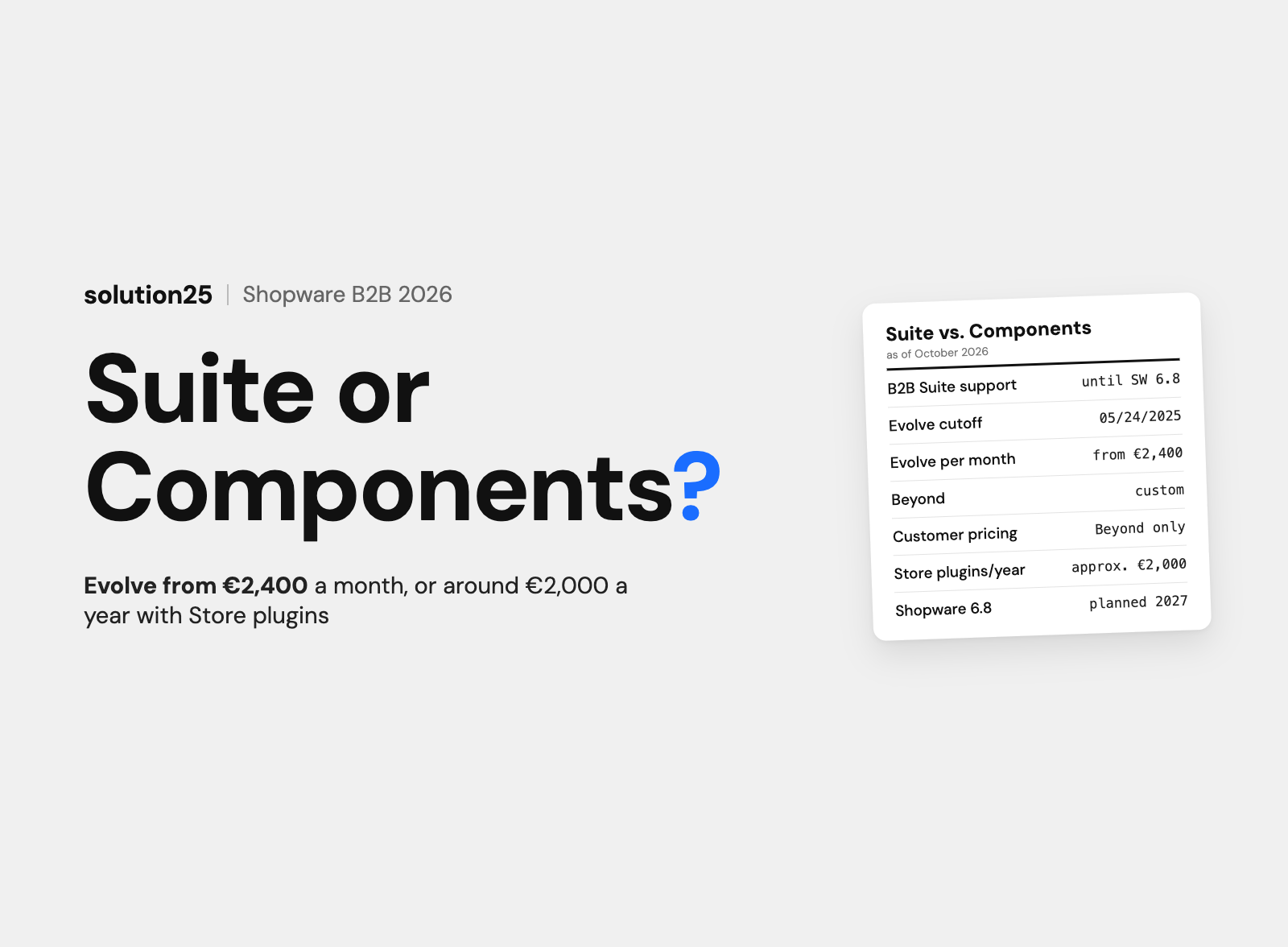
The Shopware 6 Community Edition has no license fee. Paid plans start at €600 per month (Rise) and €2,400 per month (Evolve), and Beyond is priced individually.
The license is usually the smallest line item. Implementation, hosting, extensions, and ongoing support make up most of the cost.
Realistic first-year budgets: around €25,000 for a small store, €80,000 to €120,000 for a mid-sized store with an ERP integration, and €150,000 and up for B2B.
Many merchants plan Shopware around the license price and only find out during implementation and operation where the budget actually goes. This article is for store owners and ecommerce managers at mid-sized companies who are budgeting a new Shopware store, a relaunch, or a migration from Shopware 5.
After reading it, you will be able to pick the right plan, put together a budget for year one and the years after, and check agency proposals for missing line items.
Before founding solution25, we built our own online store and grew it to more than 500 orders a day. Since 2017 we have been delivering Shopware projects for merchants, from a first store to a B2B system with ERP integration.
The numbers are based on Shopware’s official pricing, experience from our projects, and three sample budgets for different store sizes. All prices as of October 2026, excluding VAT.
| Cost block | Typical range | Due |
|---|---|---|
| Shopware license | €0 (Community Edition) to €2,400 per month (Evolve), Beyond priced individually | monthly |
| Implementation by an agency | €10,000 to €250,000, depending on scope | one-time |
| Hosting | €50 to €1,500 per month when self-hosted, included in the plan with SaaS | monthly |
| Extensions from the Shopware Store | €100 to €900 per month | monthly |
| Maintenance, updates, ongoing development | €400 to €5,000 per month | monthly |
| Payment processing | roughly 1 to 3% per transaction plus a fixed fee | per order |
A small store with a customized standard theme realistically starts at around €25,000 in year one. A mid-sized store with a custom design and an ERP integration lands at €80,000 to €120,000. The sample budgets further down show how these totals break down.
Shopware offers four plans. Prices are listed on the official pricing page. According to Shopware, the actual price of a plan depends on the Gross Merchandise Value (GMV), meaning the store’s merchandise revenue, as well as other individual factors. The amounts listed are therefore starting prices.
| Plan | Price (excl. VAT) | Best for | Support |
|---|---|---|---|
| Community Edition | €0 | Merchants with up to €1M in annual revenue who handle hosting and operations themselves | Community forum |
| Rise | from €600 per month | Growing B2C stores, bookable directly only as self-hosted | Shopware support, 8-hour response time (Mon to Fri) |
| Evolve | from €2,400 per month | B2B stores and larger B2C merchants | Phone support, 4-hour response time (Mon to Fri) |
| Beyond | custom | Enterprises with multiple locations, markets, and sales channels | 24/7 priority support, 1-hour response time, dedicated account manager |
The core of Shopware 6 is open source under the MIT license. The Community Edition comes with no license fees, and that is still the case.
Since March 24, 2025, however, there has been a Fair Usage Policy: if the stores under one Shopware account exceed €1M in GMV over the past 365 days, Shopware requires an upgrade to a paid plan. If you don’t upgrade, you lose access to your Shopware Account and the Store. The software itself keeps running.
In addition, every merchant on the Community Edition has to report their GMV to Shopware at least once a year, either through the Shopware GMV Reporting extension or via a form. So free access to the Account and the Store requires a GMV below €1M and the annual report.
GMV is the net merchandise value including shipping. Discounts reduce it, returns are not deducted.
Rise is aimed at B2C merchants who need more than the basics. The plan adds AI-powered content creation, product personalization options, returns management, and direct support from Shopware on top of the Community Edition.
Rise starts at €600 per month, so at least €7,200 per year. In practice, Rise is offered to stores with up to about €2M in annual revenue. Above that, the price goes up or Shopware points you to Evolve.
Rise can only be booked online for self-hosted stores, with a 30-day trial. SaaS and PaaS go through Shopware’s sales team.
Evolve is the B2B plan. It includes Shopware’s B2B Components: quote management, purchase approvals, roles and permissions within customer organizations, quick order, shopping lists, budget management, and features for field sales. On top of that you get advanced product search, targeted content for specific customer groups, and phone support.
At a minimum of €2,400 per month, or €28,800 per year, the jump from Rise is significant. If you don’t need the B2B features, Evolve costs you four times as much with no added value.
Beyond adds customer-specific pricing, multi-location inventory, Digital Sales Rooms, delayed actions in the Flow Builder, and around-the-clock support with a dedicated account manager to Evolve.
Shopware doesn’t publish a list price for Beyond. Industry estimates put the starting price at around €6,500 per month, but only Shopware’s individual quote is binding.
Shopware Intelligence+, the package with advanced AI features, costs €19 per month, or €29 on the Community Edition. Shopware Nexus, the integration platform, is included in every plan with a quota of executions. Each additional 1,000 executions cost €10.
Most merchants under €1M in annual revenue can go a long way with the Community Edition. It already includes the Rule Builder for pricing, shipping, and promotion rules, the Flow Builder for workflows triggered by events such as an order, the visual Page Builder, product and order management, and Shopware Payments.
Decide based on features, not plan names. Three questions are enough for a first assessment:
Our take: We advise most merchants under €1M GMV to start with the Community Edition and invest the budget in implementation and operations. You can upgrade at any time, so starting small costs you nothing. Starting too big, on the other hand, means paying every month for features nobody uses.
Shopware 6 runs in three operating models, and that choice affects your running costs more than the plan does.
You or your agency rent servers from a hosting provider and run the store yourselves. Specialized Shopware hosting in Germany costs about €50 to €100 per month for small stores, €150 to €500 for mid-sized stores with more traffic and integrations, and €1,000 and up for clustered environments with load balancing. Certified Shopware hosting partners handle the initial installation for free.
Self-hosting is the only operating model in which Rise can be booked directly online, and it gives you full control over extensions, updates, and data. We cover what to look for when choosing a server on our Shopware hosting page.
Shopware provides managed infrastructure with deployment and scaling already set up. Pricing depends on infrastructure needs and is quoted individually. PaaS makes sense for merchants with their own development team or an agency that deploys regularly. Our article on Shopware PaaS on Platform.sh shows what that looks like in practice.
Hosting, updates, and infrastructure maintenance are included in the service. In return, customization is limited, because extensions only run as apps here, not as classic plugins. You get the price from Shopware’s sales team.
For most merchants with up to €1M in revenue, self-hosting with a specialized provider is the cheapest and most flexible option. What matters is that the servers are located in Germany and that someone owns updates and monitoring.
Implementation is the largest cost block and also the one that varies the most. The following ranges come from our projects over the past few years and match what other Shopware agencies in Germany charge.
| Project type | Scope | Budget | Duration |
|---|---|---|---|
| Starter store | Customized standard theme, standard processes, one language, product import via CSV | €10,000 to €30,000 | 6 to 10 weeks |
| Mid-market | Custom design, ERP or inventory management integration, data migration, multiple languages or currencies, custom extensions | €30,000 to €90,000 | 3 to 5 months |
| B2B and enterprise | Customer-specific pricing logic, multiple sales channels, PIM, complex integrations, load testing | €90,000 to €250,000 and up | 6 to 12 months |
Specialized Shopware agencies in Germany charge hourly rates of €100 to €180, freelancers €70 to €120; the average for Shopware freelancers on Freelancermap is €80. The hourly rate alone tells you very little.
What matters is how many hours a team needs for a task, and that depends almost entirely on Shopware experience. A developer who knows the plugin structure, the Rule Builder, and the data models of Shopware 6 often needs only a third of the time a generalist would for the same task.
A fixed price only works with a clean requirements specification. If the scope is unclear, the agency prices in the risk, typically with a 15 to 25% markup. With an open scope, time and materials billing with a monthly budget cap is usually cheaper and more honest.
What no proposal should be missing: a staging environment, testing before go-live, a handover with training, and a clear agreement on who installs updates after launch.
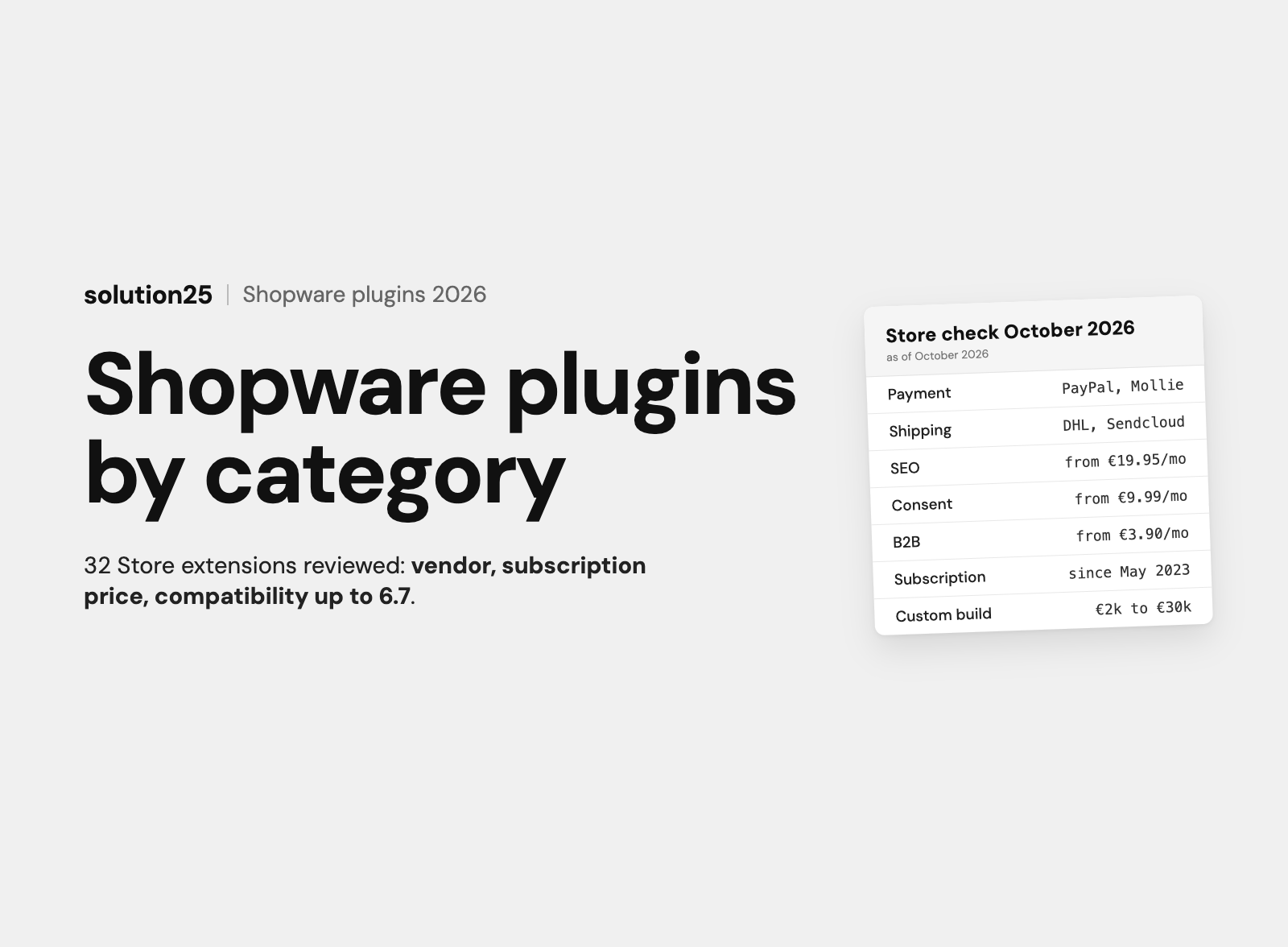
The Shopware Store has several thousand extensions, and most are now offered as subscription licenses. Individual plugins typically cost €10 to €50 per month, and specialized extensions for ERP integration, search, or B2B can run €100 or more.
An average store uses 10 to 20 plugins and pays €150 to €600 per month for them. Every plugin is also a risk during updates. Once a year it’s worth reviewing the list: which of these are still in use?
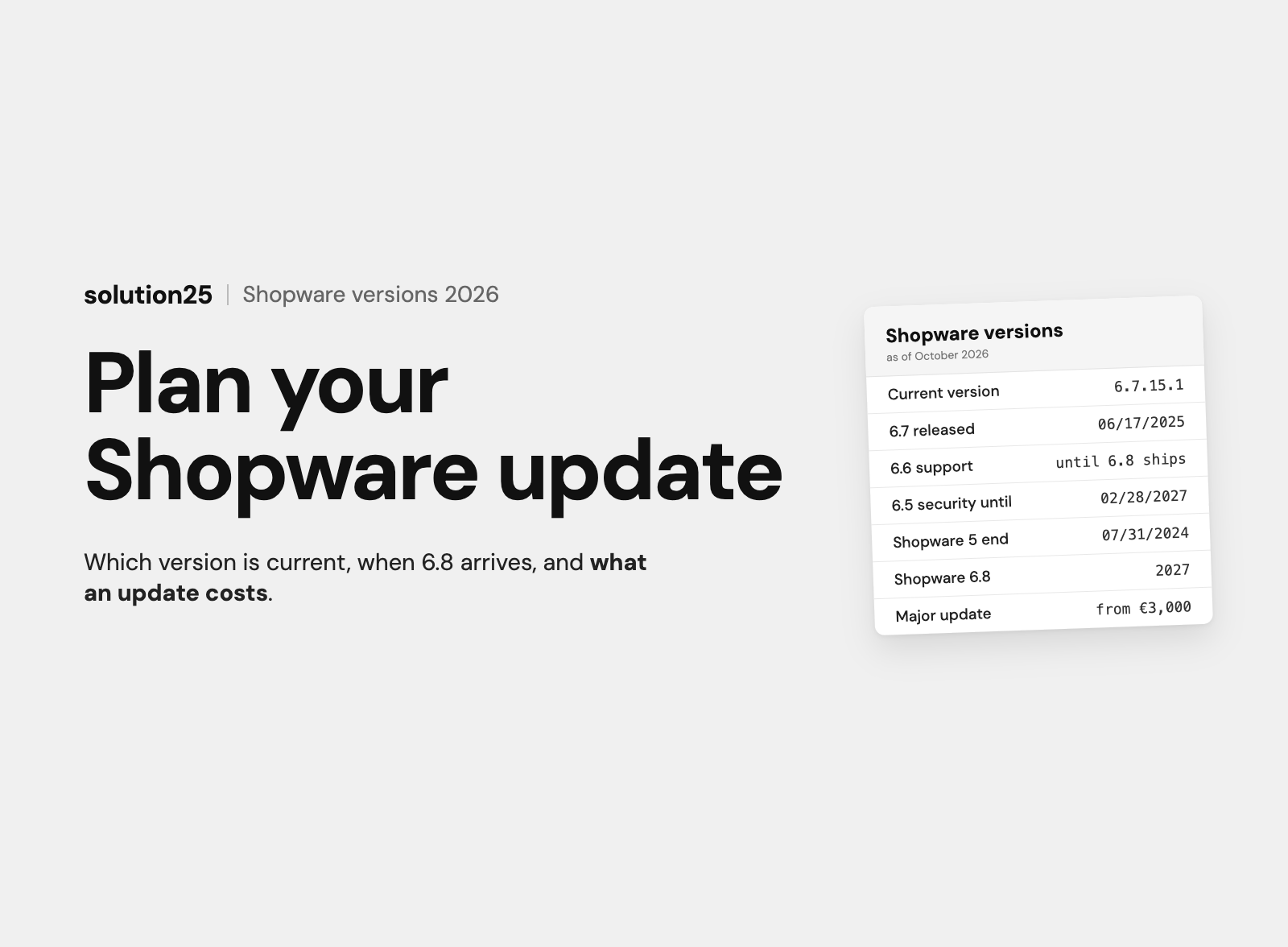
Shopware publishes patch releases, meaning bug and security fixes, every few weeks, and a new major version with new features about once a year. The current version is Shopware 6.7, released in June 2025; according to endoflife.date, the previous version 6.6 will receive security updates until February 2028.
Every update needs to be tested on the staging environment, because the theme and plugins can break, especially with version jumps like 6.6 to 6.7. Plan on €400 to €2,500 per month for maintenance, monitoring, and updates, depending on size and the number of extensions.
Ongoing development comes on top of that. A proven rule of thumb is to budget 10 to 20% of the original project cost per year for maintenance and expansion.
For growing stores, payment fees are the largest running cost, and they are missing from almost every cost breakdown. PayPal, Klarna, and credit cards usually cost a percentage of revenue plus a fixed fee per transaction. Shopware Payments, available to merchants based in Germany and Austria, also charges per transaction: at lower rates in Rise than in the Community Edition, and by individual agreement in Evolve and Beyond.
A quick example: with €50,000 in monthly revenue and average fees of 2%, you pay €1,000 per month to payment providers, more than the Rise license costs.
Newsletter tools, consent management, review tools, legal texts, and product data are easy to forget. Together they quickly add up to €100 to €300 per month.
Since June 28, 2025, Germany’s Accessibility Strengthening Act (Barrierefreiheitsstärkungsgesetz) also applies to online stores, with the only exception being microenterprises with fewer than ten employees and no more than €2M in annual revenue or balance sheet total. According to Shopware, Shopware 6.7 meets a large part of the requirements in the standard theme, but custom themes and content still need to be checked.
Our project for TonerPartner, one of the largest suppliers of printer supplies in Europe, shows how much operations drive costs. The company ran 32 online brands, each with its own codebase, its own plugins, and its own infrastructure.
According to the case study, server scaling, plugin updates, and maintaining multiple infrastructures caused high operating costs, and repeated development work slowed down updates and deployments. We consolidated the brands into a blueprint system on Shopware 6: shared core logic, plus each brand’s own design, pricing, and content.
The result according to the case study: significantly less operational effort, more stable deployments, and a 25% increase in conversion rate. The case study doesn’t put a euro figure on the savings, but the lesson for your budget is still clear: every additional codebase and every additional plugin permanently increases running costs.
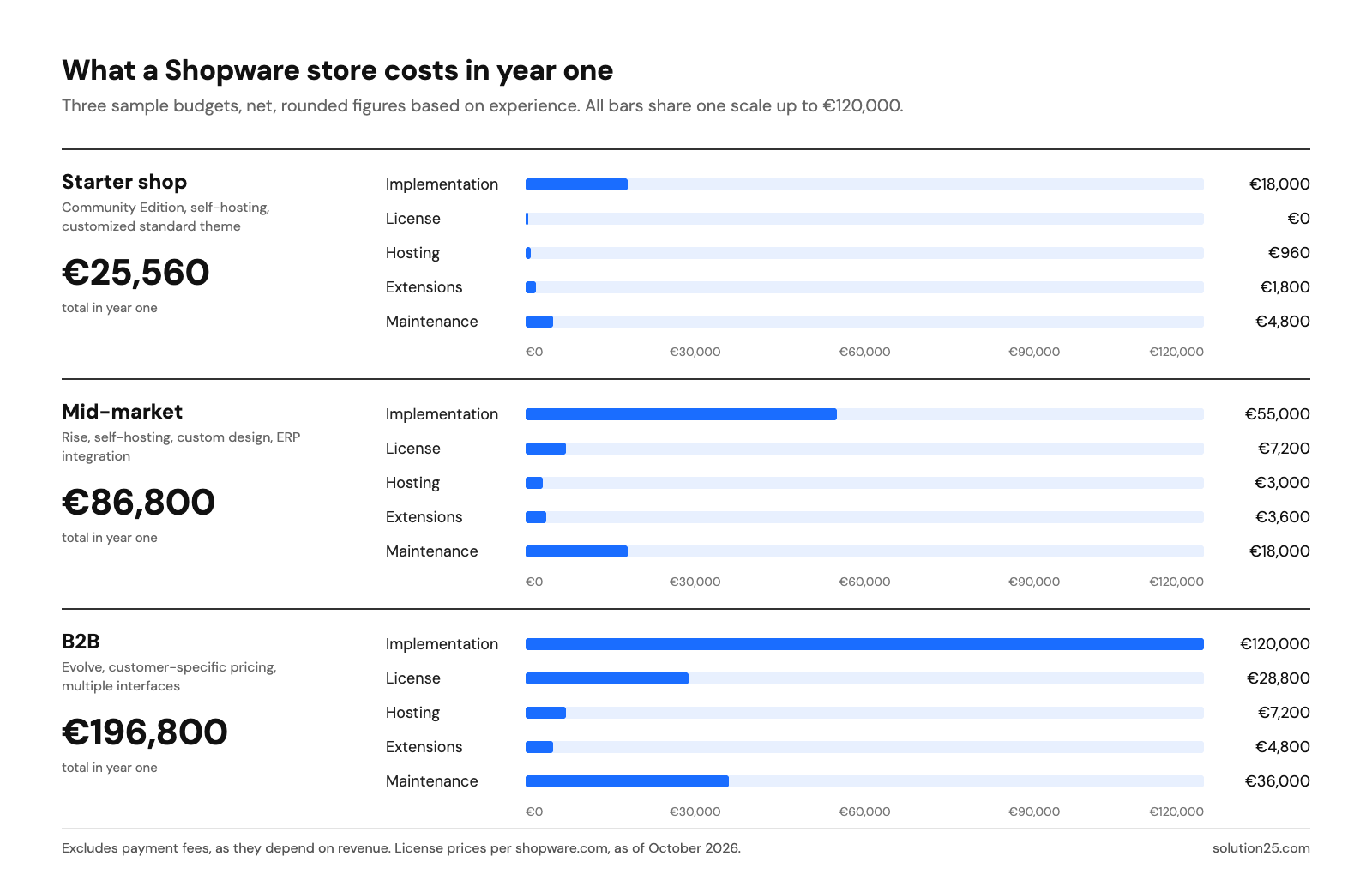
The following calculations show how the cost blocks break down in typical projects. They are rounded figures based on experience, not quotes. Their limits: payment fees are not included because they depend on revenue, and neither are internal staff costs or marketing.
| Item | Starter (Community Edition) | Mid-market (Rise) | B2B (Evolve) |
|---|---|---|---|
| Implementation, one-time | €18,000 | €55,000 | €120,000 |
| Shopware license per year | €0 | €7,200 | €28,800 |
| Hosting per year | €960 (€80 per month) | €3,000 (€250 per month) | €7,200 (€600 per month) |
| Extensions per year | €1,800 (€150 per month) | €3,600 (€300 per month) | €4,800 (€400 per month) |
| Maintenance and development per year | €4,800 (€400 per month) | €18,000 (€1,500 per month) | €36,000 (€3,000 per month) |
| Total year one | €25,560 | €86,800 | €196,800 |
| Each following year | €7,560 | €31,800 | €76,800 |
The license share stands out: zero for the starter store, around 8% of year-one costs for the mid-market store, and around 15% for the B2B store. That’s why the Rise vs. Community Edition debate is rarely the most important one. What matters more is whether the implementation is properly planned and whether someone owns operations.
Shopware 5 has been officially discontinued since July 31, 2024 and no longer receives regular security updates. If you are still selling on Shopware 5, you are running a system whose vulnerabilities nobody is systematically fixing anymore.
Moving to Shopware 6 is not an update, it’s a new project: data can be transferred with the migration assistant, the theme and plugins have to be rebuilt or replaced, and the SEO structure needs clean redirects. Small stores come in at around €20,000, mid-sized stores with integrations and custom plugins at €40,000 to €120,000.
Our page on migrating from Shopware 5 to 6 explains how we approach it and the common pitfalls. We cover what to watch for to protect your Google visibility during the switch under SEO for platform migrations.
We build on all three platforms, so here is an honest comparison.
| Criterion | Shopware 6 | Shopify | WooCommerce |
|---|---|---|---|
| License | €0 to €2,400 per month, Beyond priced individually | Monthly fee depending on plan, low entry price | Plugin is free, WordPress hosting required |
| Fee per order | None | Yes, unless Shopify Payments is used | None |
| Extensions | Store plugins as subscription licenses, custom plugins possible | Apps with monthly fees | Plugins, many free, quality varies |
| Customizability | Full access to code and data | Limited, theme and apps | High, but maintenance-heavy |
| B2B | Strong (Evolve, B2B Components) | Limited, only in expensive plans | Only via plugins |
| Best for | Merchants with their own processes, integrations, B2B | Fast launch, simple catalogs | Small catalogs, content-heavy stores |
Shopify is cheaper to get started with, but costs grow with revenue and customization is limited. WooCommerce is the cheapest option for small catalogs, but with many products, variants, and integrations the maintenance effort rises sharply. Shopware has the highest entry price, but it gives you full control over code and data and is the strongest of the three for B2B. If you’re coming from Shopify, you’ll find the details on our page about migrating from Shopify to Shopware 6.
Monthly price instead of a project budget: For small stores, we also offer the store as a store subscription. Our team builds, populates, and runs it starting at €299 per month, with no setup fee and hosting on servers in Germany. The minimum term is 24 months, after which the store is yours.
A budget only helps if you regularly compare it with actual costs. We recommend these metrics; the benchmarks come from this article or from experience in our projects:
The Community Edition is free and open source. You still pay for hosting, implementation, extensions, and payment processing. Once you reach €1M in annual revenue, Shopware requires an upgrade to a paid plan.
The license costs €0 (Community Edition), from €600 (Rise), or from €2,400 (Evolve) per month, and Beyond is quoted individually. Including hosting, extensions, and maintenance, running costs for a small store come to €600 to €1,000 per month, and €2,500 to €3,500 for a mid-sized store on Rise.
The plans are Community Edition, Rise, Evolve, and Beyond. The software version is a separate thing: the current version is Shopware 6.7, and version 6.6 will receive security updates until February 2028. Shopware 5 has been out of support since July 2024.
A starter store costs €10,000 to €30,000, a mid-sized store with ERP integration and a custom design €30,000 to €90,000, and a B2B or enterprise project €90,000 and up. On top of that come running costs for hosting, extensions, and support.
GMV stands for Gross Merchandise Value, the net merchandise revenue including shipping. Shopware ties the price of its plans to this value: the higher the revenue, the higher the plan price. For the Community Edition, the cap is €1M over 365 days, after which a paid plan is required.
It depends on your business model. Shopify is cheaper to start with and faster to launch, while Shopware is more flexible, charges no fee per order, and is much stronger for B2B. For merchants with their own processes, integrations, and more than a few hundred products, Shopware is usually the more cost-effective choice from year two onward.
In German-speaking markets, the main ones are Shopify, WooCommerce, JTL-Shop, OXID eShop, and, for large corporations, Adobe Commerce (Magento). Which alternative fits depends on your catalog, integrations, share of B2B, and the team that runs the store.
Yes, if the store is meant to grow. With the Community Edition, a standard theme, and specialized hosting, a small store launches for around €25,000 in year one and gets a system that scales into seven-figure revenue without needing a platform switch.
Planning a new store or a move to Shopware 6? Send us your requirements list: we’ll estimate the effort per line item, calculate year one and the following years, and tell you which edition you actually need.
Already running a store? Our free store audit shows where you’re leaving revenue on the table today and what an optimization or a platform switch would deliver.
Learn more about how we work, our certifications, and our locations on the Shopware agency solution25 page.

Besnik Bilalli is the founder and CEO of solution25, the Shopware agency from Bremen. Before founding the agency in 2017, he built his own online store and grew it to more than 500 orders a day. Since then he has been helping merchants with Shopware projects, from the first budget to ongoing operations. He’s happy to answer questions about this article personally: get in touch.
Responsible for content and updates: Besnik Bilalli. Last updated: October 2026. Next content review: January 2027.