
Logo Dark
  • Ecommerce

    See where your store can improve.

    Get Your Free Audit
    Frame 1321315514

    Shopware

    Platinum Partner, now in the US

    More
    Shopware Core Concepts Arrow Up Right Who Uses Shopware? Arrow Up Right Become a Good Shopware Partner Arrow Up Right Shopware Hosting Arrow Up Right Shopware Pre Go-Live Checklist Arrow Up Right Why Shopware in 2025? Arrow Up Right B2B on Shopware Arrow Up Right B2C on Shopware Arrow Up Right Shopware Performance Arrow Up Right Shopware Paas on Platform.sh Arrow Up Right Shopware for the U.S Market Arrow Up Right Shopware Seo Guide Arrow Up Right
    Frame 1321315514 1

    Shopify

    Fast to launch, built to scale

    More
    What is Shopify? Arrow Up Right Who should use Shopify? Arrow Up Right What can you do with Shopify? Arrow Up Right How much does Shopify cost? Arrow Up Right How do you choose your Shopify theme? Arrow Up Right Can you connect Amazon to Shopify? Arrow Up Right Who Owns Shopify? Arrow Up Right Shopify Disadvantages Arrow Up Right Benefits of Shopify Arrow Up Right
    Frame 1321315514 19

    Magento

    Complex catalogs and B2B

    Coming soon
    Frame 1321315514 18

    WooCommerce

    Flexible commerce for growing businesses

    Coming soon
    Frame 1321315514 2

    Migrations

    Move platforms without disrupting revenue

    More
    Shopware 5 to Shopware 6 Arrow Up Right Shopify to Shopware 6 Arrow Up Right Magento to Shopware 6 Arrow Up Right Oxid to Shopware 6 Arrow Up Right Migrations Arrow Up Right Prep for Shopware Platform Migrations Arrow Up Right Our Shopware Process Arrow Up Right Painful Shopware 6 Migrations if Done Wrong Arrow Up Right Shopware Prep: Historical Order Data Arrow Up Right Shopware Data Ready Arrow Up Right Shopware Content Migrations Arrow Up Right SEO Considerations in Platform Migrations Arrow Up Right
    Frame 1321315514 3

    Integrations

    Payments, tax, fulfillment, marketing

    More
    Shopware 5 Optimizely Campaign Arrow Up Right Shopware 6 Optimizely Campaign Arrow Up Right Shopware 6 PayTrace Payment Arrow Up Right Shopware 6 NMI Payment Arrow Up Right Shopware 6 MaxMind Fraud Prevention Arrow Up Right Shopware 6 Quotes & Customer-Specific Pricing Arrow Up Right Shopware 6 Subscription Arrow Up Right Shopware 6 Listrak Arrow Up Right Shopware 6 Multi Channel Arrow Up Right Shopware 6 Partial Delivery Arrow Up Right Shopware 6 AgeChecker.net Arrow Up Right Shopware 6 Pudo Point Arrow Up Right Why API First Opens Doors? Arrow Up Right Reduce the cost of ERP integrations Arrow Up Right PyPal Payment Provider Arrow Up Right Klaviyo Integration Guide for Shopware 6 Arrow Up Right Klaviyo - Email Marketing Integration Arrow Up Right Reviews.io Integration Guide for Shopware 6 Arrow Up Right Hubspot - Integration for Shopware 6 Arrow Up Right Mailchimp - Email Marketing Integration Arrow Up Right Google Analytics - Integration Guide Arrow Up Right Integrate Zapier with Shopware 6 Arrow Up Right Shopware 6 BlueSnap Arrow Up Right Shopware 6 Cybersource Arrow Up Right Shopware 6 Abandoned Cart Saver Arrow Up Right Shopware 6 Store Credit Arrow Up Right
    Frame 1618873659

    Start your Shopware migration with us.

    Learn more
    Shopware – Overview Shopware Core Concepts Arrow Up Right Who Uses Shopware? Arrow Up Right Become a Good Shopware Partner Arrow Up Right Shopware Hosting Arrow Up Right Shopware Pre Go-Live Checklist Arrow Up Right Why Shopware in 2025? Arrow Up Right B2B on Shopware Arrow Up Right B2C on Shopware Arrow Up Right Shopware Performance Arrow Up Right Shopware Paas on Platform.sh Arrow Up Right Shopware for the U.S Market Arrow Up Right Shopware Seo Guide Arrow Up Right
    Shopify – Overview What is Shopify? Arrow Up Right Who should use Shopify? Arrow Up Right What can you do with Shopify? Arrow Up Right How much does Shopify cost? Arrow Up Right How do you choose your Shopify theme? Arrow Up Right Can you connect Amazon to Shopify? Arrow Up Right Who Owns Shopify? Arrow Up Right Shopify Disadvantages Arrow Up Right Benefits of Shopify Arrow Up Right
    Migrations – Overview Shopware 5 to Shopware 6 Arrow Up Right Shopify to Shopware 6 Arrow Up Right Magento to Shopware 6 Arrow Up Right Oxid to Shopware 6 Arrow Up Right Migrations Arrow Up Right Prep for Shopware Platform Migrations Arrow Up Right Our Shopware Process Arrow Up Right Painful Shopware 6 Migrations if Done Wrong Arrow Up Right Shopware Prep: Historical Order Data Arrow Up Right Shopware Data Ready Arrow Up Right Shopware Content Migrations Arrow Up Right SEO Considerations in Platform Migrations Arrow Up Right
    Integrations – Overview Shopware 5 Optimizely Campaign Arrow Up Right Shopware 6 Optimizely Campaign Arrow Up Right Shopware 6 PayTrace Payment Arrow Up Right Shopware 6 NMI Payment Arrow Up Right Shopware 6 MaxMind Fraud Prevention Arrow Up Right Shopware 6 Quotes & Customer-Specific Pricing Arrow Up Right Shopware 6 Subscription Arrow Up Right Shopware 6 Listrak Arrow Up Right Shopware 6 Multi Channel Arrow Up Right Shopware 6 Partial Delivery Arrow Up Right Shopware 6 AgeChecker.net Arrow Up Right Shopware 6 Pudo Point Arrow Up Right Why API First Opens Doors? Arrow Up Right Reduce the cost of ERP integrations Arrow Up Right PyPal Payment Provider Arrow Up Right Klaviyo Integration Guide for Shopware 6 Arrow Up Right Klaviyo - Email Marketing Integration Arrow Up Right Reviews.io Integration Guide for Shopware 6 Arrow Up Right Hubspot - Integration for Shopware 6 Arrow Up Right Mailchimp - Email Marketing Integration Arrow Up Right Google Analytics - Integration Guide Arrow Up Right Integrate Zapier with Shopware 6 Arrow Up Right Shopware 6 BlueSnap Arrow Up Right Shopware 6 Cybersource Arrow Up Right Shopware 6 Abandoned Cart Saver Arrow Up Right Shopware 6 Store Credit Arrow Up Right
  • Software & AI

    See where your store can improve.

    Get Your Free Audit
    Frame 1321315514 4

    Software Development

    Platforms and portals, systems connected

    Coming soon
    Frame 1321315514 5

    App Development

    Web and mobile apps, API-first

    Coming soon
    Frame 1321315514 6

    AI Development

    Models connected, data enriched, assistants

    Coming soon
    Frame 1321315514 7

    Replatforming

    Switch platforms without losing revenue

    More
    Frame 1321315514 8

    All Integrations

    Payments, tax, fulfillment, marketing

    More
    Frame 1618873659 1

    Discover our latest Shopware plugin. MCP Connector.

    Explore the plugin
  • Solutions

    See where your store can improve.

    Get Your Free Audit

    Further links

    Frame 1321315514 16 GitHub Arrow Up Right Frame 1321315514 17 Shopware Store Arrow Up Right
    Frame 1321315514 10

    Shopware Plugins

    Extensions built by our team

    More
    Frame 1321315514 11

    Optimizely Integrationen

    Campaigns, automation and customer engagement

    More
    Frame 1321315514 12

    Lavet

    Migration and integration platform

    More
    Frame 1321315514 13

    StatHubs

    All store metrics in one dashboard

    Coming soon
    Frame 1321315514 21

    Pathway

    By Boldest, in partnership with solution25

    More
    Frame 1618873659 2

    Discover our Optimizely Campaign plugin.

    Explore the plugin
  • Company

    See where your store can improve.

    Get Your Free Audit

    About

    Events & Summit

    Resources

    Careers

    Frame 1618873659 3

    Built by people who know commerce.

    Chevron Right White
  • Blog
  • Contact
  • Language: EN

    Select Language

    • DE
    • EN
    • AT
    • CH
    • NL
    • UK
    • IT
+1 929-264-76 02
  • DE
  • AT
  • CH
  • NL
  • UK
  • IT
  • Free consultation
    1. Home /
    2. Shopware Update and Versions 2026: 6.7, 6.8, Shopware 7, and a Safe Process
    Shopware Update Versions Title Image
    25 September 2026

    Shopware Update and Versions 2026: 6.7, 6.8, Shopware 7, and a Safe Process

    Besnik Bilalli
    Besnik Bilalli, Founder and CEO of solution25Updated November 5, 2026 · 21 min read

    Shopware 6.7 is current, 6.8 has been pushed to 2027, and no Shopware 7 has been announced. Every version with its end of support, the update process in eight steps, common mistakes, and the cost per update.

    The short answer

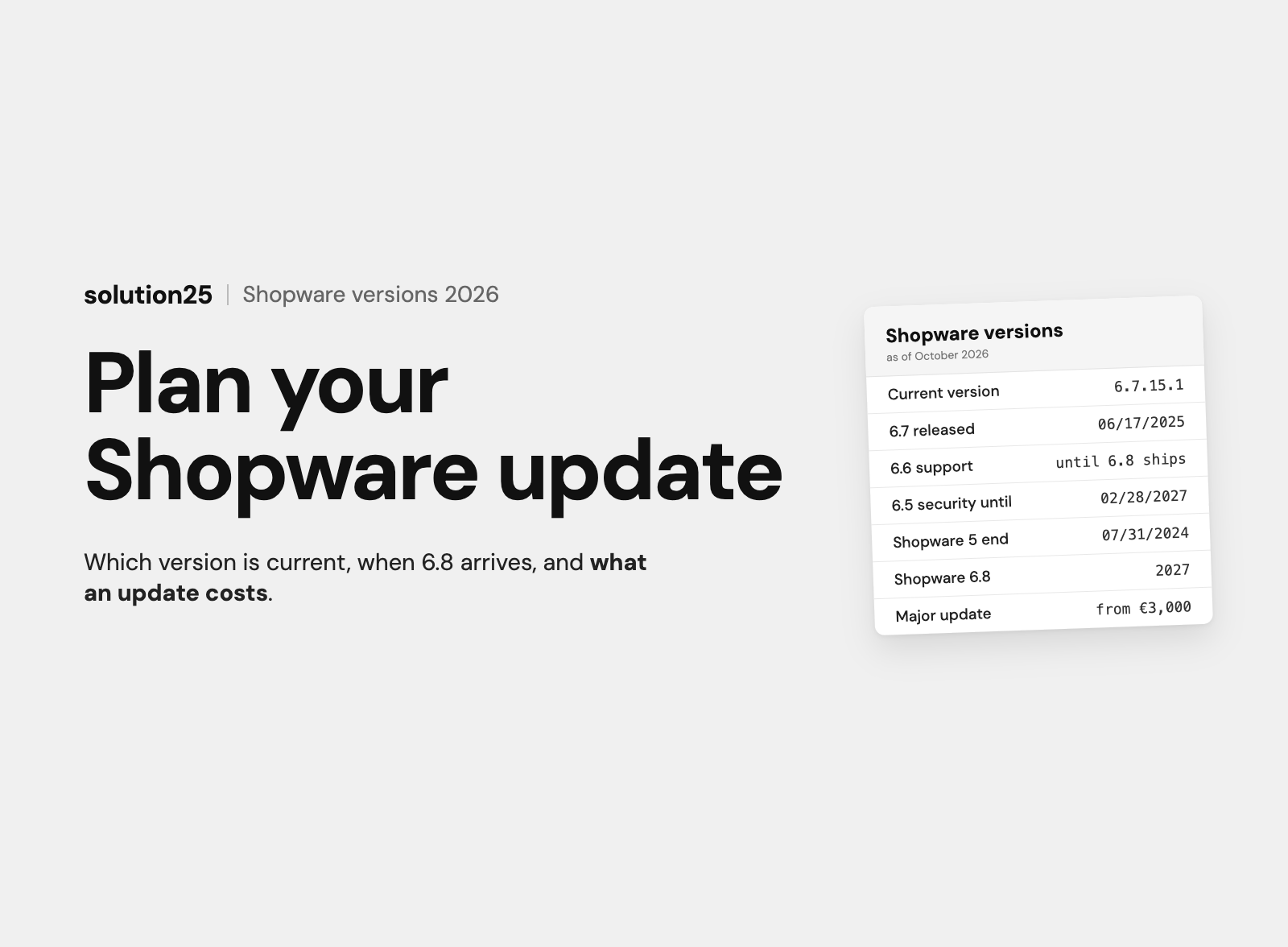
    The current Shopware version is 6.7, released on June 17, 2025, most recently updated to 6.7.15.1 on October 7, 2026. Shopware 6.6 is in extended support, 6.5 only receives security updates until February 28, 2027, and Shopware 5 has been discontinued since July 31, 2024.

    The next major version is called 6.8 and is planned for 2027. Shopware pushed it back by a year in November 2025. A “Shopware 7” has not been announced; everything you read about it online is speculation.

    A safe Shopware update needs staging, a backup, and a plugin check, not just a click in the Administration. Professionally run stores update via Composer or the Shopware CLI. With an agency, a minor update costs €500 to €2,000 and a major update €3,000 to €15,000.

    Before founding solution25, we ran our own online store and know what a failed update on a Monday morning means. Since 2017 we have been supporting Shopware stores in day-to-day operations, and updates are among the tasks we handle most often.

    A store that keeps putting off updates first loses security support and then plugin compatibility, and every skipped major version makes the next step more expensive. This article is for store owners and ecommerce leads running their own Shopware store who want to check their version and plan the next update.

    After reading it, you’ll be able to assess your version, determine the deadline for your next update, and plan an update with process, budget, and test plan yourself, or brief your agency precisely. You’ll also learn what is confirmed about 6.8 and a possible Shopware 7. All prices as of October 2026, excluding VAT.

    Contents

    1. The short answer
    2. Shopware versions in 2026: which version is current and how long it gets support
    3. What's different in Shopware 6.7
    4. Shopware 6.8 and Shopware 7: what has been announced and what hasn't
    5. How to run a Shopware update: the process in eight steps
    6. Web updater, Composer, or Shopware CLI: three ways to update Shopware 6
    7. Common mistakes: where updates fail on plugins, themes, and integrations
    8. What a Shopware update costs
    9. Shopware 5 update: why there isn't one anymore and what to do instead
    10. Which update strategy fits your store?
    11. Frequently asked questions about Shopware updates and versions
    12. Your next Shopware update, without the risk
    13. Further reading

    Shopware versions in 2026: which version is current and how long it gets support

    Shopware maintains several version lines in parallel. The following table summarizes the status as of October 28, 2026; the data comes from Shopware’s release calendar, endoflife.date, and the official changelog.

    Version Released Status in October 2026 Security updates until What to do
    Shopware 6.7 June 17, 2025 Current major version, monthly minor releases, latest 6.7.15.1 Open, at least until 6.8 is released (endoflife.date tentatively lists February 28, 2028) Install minor updates regularly
    Shopware 6.6 March 21, 2024 Extended support with direct patches (6.6.10.x, latest 6.6.10.30) According to Shopware, until 6.8 is available; endoflife.date lists February 28, 2028 Plan the update to 6.7 within the next twelve months
    Shopware 6.5 May 3, 2023 Security updates only, via the Security Plugin February 28, 2027 Complete the update to 6.6 and 6.7 by early 2027
    Shopware 6.4 May 4, 2021 End of support May 14, 2025 Update immediately, via 6.5 and 6.6 to 6.7
    Shopware 5 (5.7) May 26, 2021 Discontinued July 31, 2024 Migrate to Shopware 6, which is a project in its own right

    If you’re on 6.7, install the monthly releases. If you’re on 6.6 or 6.5, you have a major update ahead of you, and for 6.5 it gets serious in early 2027.

    Key terms explained

    • Major, minor, patch: A major version with deep changes (6.7.0.0), a monthly feature release (6.7.15.0), and a fix for bugs or security vulnerabilities (6.7.15.1).
    • Extended support: The phase after the next major version is released, during which the previous one still receives direct patch updates.
    • Security Plugin: A free extension Shopware uses to close security vulnerabilities in older versions without publishing a new version.
    • Staging environment: A non-public copy of the store where updates are tested before they go live.
    • Composer: The tool that installs and updates Shopware and its extensions as packages with pinned versions.
    • Shopware CLI: A command line tool from Shopware that, among other things, pre-checks and runs updates.
    • Breaking change: A change after which existing plugin or theme code has to be adjusted.
    • Changelog: The list of all changes in a version, published by Shopware.

    What extended support and security support mean

    Since February 2024, a new release policy has applied: Shopware publishes one major version per year. The last minor version of the previous major gets direct patch updates with selected bug fixes and security updates for one year, until the next major version replaces it.

    After that comes another year in which only security vulnerabilities are fixed, through the free Shopware Security Plugin rather than new versions. Together that adds up to two years of support per major version. The plugin comes in the 4.x line for 6.7, 3.x for 6.6, and 2.x for 6.5; the 1.x line for 6.4 is no longer maintained.

    Because Shopware 6.8 was pushed to 2027, Shopware extended the extended support for 6.6 until 6.8 is available. You can see it in the changelog: on September 16, 2026, security updates 6.7.14.1 and 6.6.10.25 were released on the same day.

    How Shopware version numbers work

    Shopware 6 uses four digits: the 6 stands for the product generation, followed by major, minor, and patch. 6.7.0.0 was the major release, 6.7.1.0 the first minor release, and 6.7.14.1 a patch. The release type follows from which position holds the zero.

    According to the release policy, a major comes out once a year, a minor on the first Monday of every month, and a patch as needed, for example for security vulnerabilities. About two months before each major there is a release candidate, meaning a preview version for testing, and Shopware SaaS is updated weekly. Our article on the Shopware changelog explains how to read the entries and which details matter.

    Important for planning: minor and patch releases are built so that extensions keep working without changes. Shopware promises this in its Backward Compatibility Promise. Anything that breaks code is saved for major releases and deprecated in advance with a note on the target version.

    What's different in Shopware 6.7

    Shopware itself says that major versions aren’t feature bundles but lay the technical foundation for the following year’s minor releases. That was especially true for 6.7 from June 17, 2025, because the rebuild mainly affected the Administration, caching, and accessibility.

    • Vite instead of Webpack: The Administration is built with Vite, a tool that bundles code for the browser. Plugins with their own admin components therefore need separate versions for 6.6 and 6.7, as stated in the 6.7 Update Guide.
    • Vue 3 without the compatibility layer: Vue, the Administration’s JavaScript framework, runs without the Vue 2 compatibility layer. Admin modules that still relied on Vue 2 behavior have to be adjusted.
    • Pinia instead of Vuex: The Administration’s state management switches to Pinia. Old Vuex stores keep working, and the helpers have been renamed.
    • Meteor components: Base components like sw-button have been replaced by the Meteor library (mt-button, mt-tabs). Custom admin interfaces need to be migrated.
    • Cache rebuild: Cache invalidation is delayed, every five minutes by default. Caching of Store API routes has been removed, and the header and footer are loaded via ESI (Edge Side Includes) as separately cached blocks.
    • Accessibility: A 1rem base font size, icons with aria-hidden, buttons instead of links for modals, and pagination as anchor links. This is the technical foundation for Germany’s Accessibility Strengthening Act (Barrierefreiheitsstärkungsgesetz), in effect since June 28, 2025.
    • Libraries: DBAL 4 (database layer), PHPUnit 11 (testing framework), DomPDF (PDF generation), and OAuth2 Server (API authentication) were updated, and since 6.7.2 all Symfony components run on version 7.3. Payment handlers were consolidated into the new AbstractPaymentHandler, and custom entities for plugins were removed.
    • File system (Flysystem): Since 6.7.1, file system visibility is configured at the same level as the type, and the old setting in the config array is deprecated. If you store media on S3, a cloud storage service, check your configuration.

    System requirements for 6.7 according to Shopware: PHP 8.2 to 8.4, Node.js 20 or later, MySQL 8.0.17 or later or MariaDB 10.11 or later, and optionally Redis 7.0 or later. Our article on Shopware hosting helps you check whether your server meets them.

    What the minor releases since 6.7.0 have brought

    The features then arrived monthly: 6.7.1 in July 2025 with expanded B2B Components and units of measure per sales channel, 6.7.2 in September with performance and SEO improvements, 6.7.4 in November with expanded subscriptions, 6.7.5 in December with more flexible SEO control, and 6.7.7 in February 2026 with a redesigned cookie consent and better GA4 integration.

    As of October 2026, the line is at 6.7.15.1. So if you haven’t updated since summer 2025, you’re missing more than a year of features, bug fixes, and security updates, even though the version is still “6.7”.

    Shopware 6.8 and Shopware 7: what has been announced and what hasn't

    Shopware 6.8 is coming in 2027

    On November 12, 2025, Shopware announced that the next major version, 6.8, will be released in 2027 instead of 2026. Shopware cites the balance between progress, stability, and developer experience as the reason, and notes that the minor releases have been delivering the key innovations anyway.

    Until then, Shopware is focusing on three areas: stability, performance, and security of the platform; better documentation and developer experience; and new features for agentic AI, meaning AI agents that carry out tasks on their own. At the same time, extended support for 6.6 was extended until 6.8 is available.

    What 6.8 will remove is already marked in the code today: deprecated features carry the target version 6.8.0, such as the admin translation function $tc. The feature flags, meaning switches for innovations you can use early, for the cache rebuild and the redesigned webhooks are optional in 6.7 and become the default with 6.8. If you run custom plugins, work through these deprecations now, and the 2027 major update will be a small step.

    There is no Shopware 7, and it hasn’t been announced

    As of October 28, 2026, there is no announcement of a “Shopware 7” on shopware.com, in the developer documentation, or in the release calendar. The latest official statement about the next major version concerns 6.8. The agency pages that rank on Google for the term confirm this too: they describe expectations, not facts.

    The versioning logic also argues against a 7 coming soon: the leading 6 stands for the platform generation based on Symfony and Vue, and the major versions count up behind it. A real generational change like Shopware 5 to 6 wouldn’t be an update but a migration, and there is currently no sign of that.

    How to run a Shopware update: the process in eight steps

    The process is the same for minor and major updates; only the scope and depth of testing differ. It combines Shopware’s guide and the notes on hosting and deployment with our own practice.

    1. Read the changelog and upgrade notes: Determine the release type. For a major, every breaking change is listed in the UPGRADE-6.x.md file on GitHub; for minor releases, a look at the Release News is enough.
    2. Check extensions: The updater in the Administration shows one of three states for each extension: already compatible, updatable after the update, or incompatible with no successor version. The last group has to be replaced or removed beforehand.
    3. Check system requirements: PHP version, database, and Node.js must match the target version. For major updates, Shopware recommends raising PHP to the minimum version before the Shopware update.
    4. Update the staging environment: Since 6.6.1 there is the system:setup:staging command, which puts a copy of the live store into staging mode: email sending off, domains rewritten, a banner in the admin and the storefront. The database comes over anonymized via shopware-cli project dump. We describe how such a staging environment is set up separately.
    5. Back up the live environment: Database and files, right before the update. Shopware doesn’t create backups itself; that’s up to your hosting provider or agency.
    6. Maintenance mode and update: Deploy the code, then run sales-channel:maintenance:enable, system:update:prepare, and system:update:finish. The last command runs the database migrations and recompiles the themes.
    7. Follow-up tasks: Clear the cache, rebuild the indexes if you use Elasticsearch or OpenSearch, update the Security Plugin to the matching line, and end maintenance mode.
    8. Testing and monitoring: Login, cart, checkout with every payment method, ERP and payment provider integrations, admin functions, load times, logs.

    Shopware itself advises in its guide: “Only start an update if you have the relevant experience”; otherwise, your partner agency should run the update.

    Web updater, Composer, or Shopware CLI: three ways to update Shopware 6

    Which of the three routes fits depends on the size of the store and whether someone works with shell access and Git.

    Method Best for Process Limitations
    Web updater in the Administration Small stores without developers, few extensions Settings, System, Shopware Update: check requirements and extensions, confirm the backup, install. Maintenance mode, download, and migrations run automatically Shopware only recommends it for small instances: browser timeouts, memory limits, no version history in Git
    Composer, manual All professionally run stores, possible since 6.3 Set the target version in composer.json, composer update, composer recipes:update, commit, deploy, then system:update:finish on the server Requires shell access, Git, and someone who can read dependency conflicts
    Shopware CLI (project upgrade) Agencies, teams with CI/CD, stores with many extensions An assistant checks readiness, sorts extensions into ready, update needed, check manually, or blocked, runs the Composer update, and writes a report All extensions must be managed via Composer, locally stored plugins block the check

    Why we recommend Composer and the Shopware CLI

    The Composer route makes every update traceable: composer.json and composer.lock live in Git, every change has a commit, and rolling back the code takes one command. Shopware’s own guide describes this route as more stable because it doesn’t cause timeouts. Our article on Composer for Shopware explains exactly what Composer does here.

    The shopware-cli project upgrade assistant goes one step further. With the --dry-run parameter, it only checks and writes a report to .shopware-cli/upgrade/report.md, containing the target version, PHP requirements, planned package changes, and the status of every extension. If a step fails, the assistant restores composer.json and composer.lock.

    On rollbacks: blue-green deployments, which switch between two parallel environments, let you return to the old version without a database restore, but only if nothing but Shopware was updated. As soon as extensions have run their own migrations, the backup is the only way back.

    Common mistakes: where updates fail on plugins, themes, and integrations

    The Shopware software itself is rarely the problem. In our projects, updates almost always go wrong in the same places.

    • Admin plugins without a 6.7 version: Since the switch to Vite and Vue 3, every plugin with an admin interface needs its own version for 6.7. If it’s missing, the updater deactivates the plugin and features suddenly disappear from the admin.
    • Theme overrides: Custom Twig blocks that Shopware has changed in the standard lose their effect or throw errors. For this, Shopware offers Twig Block Versioning as a plugin for the PhpStorm IDE, which flags overridden blocks.
    • Internal and experimental interfaces: Plugins that use code marked @internal or @experimental fall outside the compatibility promise. Those spots break even on minor updates.
    • Cache behavior after 6.7: Price changes or new products show up in the storefront up to five minutes later than you’re used to. That’s not a bug but the delayed invalidation, which can be configured.
    • Search index: Stores with Elasticsearch or OpenSearch need a full reindex after some 6.7 releases, or products go missing from listings.
    • Payment plugins: 6.7 consolidated the payment handlers into a new base class. Older payment plugins have to be updated, or checkout breaks.
    • Skipped versions: Going from 6.5 straight to 6.7 isn’t supported. Shopware explicitly advises against skipping major versions without having tested the full path.
    • No staging: On staging, each of these points is a note in the test log; in the live store, it’s an outage with lost revenue.

    If you develop your own plugins, Rector for Shopware and the codemods for the Administration save a lot of manual work. Both tools rewrite deprecated code, but the results need to be reviewed. We describe how to make custom plugin development update-proof from the start separately.

    From our projects: plugins that keep up with platform updates

    For Optimizely, we develop and maintain plugins that run on Shopware 5 and 6, WooCommerce, Magento, and Shopify. The shared logic sits in a core, and platform-specific adaptations live in separate extensions.

    The plugins stay update-proof thanks to a fixed maintenance process: automated tests against new platform versions, patch releases, and monitoring that surfaces regressions, meaning bugs in previously working flows, early. According to the project report, the plugins run stably even through platform updates, emergency fixes are rarer, and Optimizely’s teams have fewer platform-specific escalations.

    For your store, this means: the more custom plugins you run, the more an automated test that checks every new Shopware version before it goes live pays off.

    What a Shopware update costs

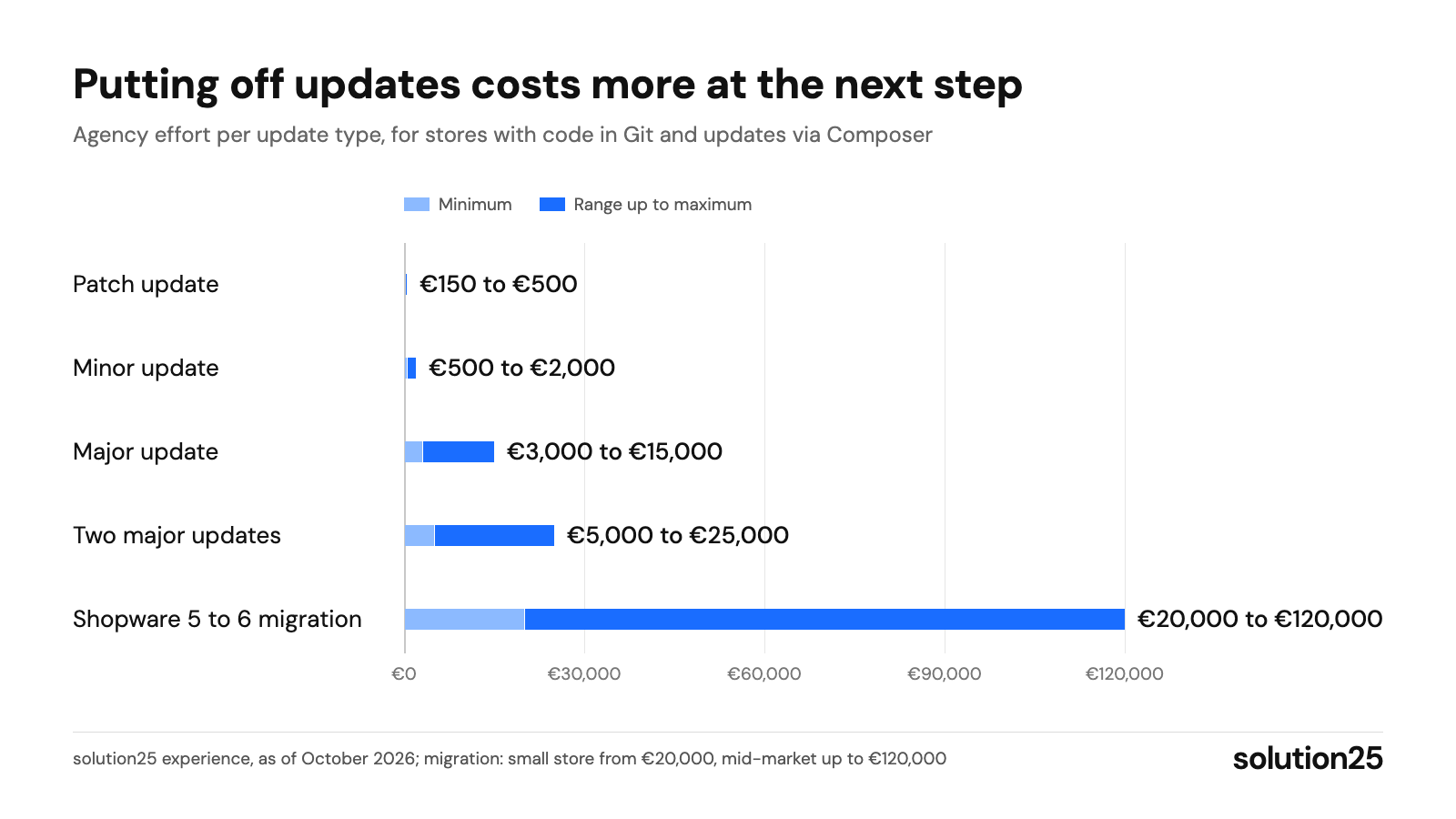
    The following ranges are based on experience from our projects, not quotes. They assume the code lives in Git and the store is updated via Composer. If you need to clean up first, that effort comes on top as a one-time cost.

    Update type Example Cost with an agency Duration
    Patch or security update 6.7.14.0 to 6.7.14.1 Usually included in the maintenance contract, €150 to €500 on its own 1 to 3 hours including staging test
    Minor update 6.7.12 to 6.7.15 €500 to €2,000 Half a day to two days
    Major update 6.6 to 6.7 €3,000 to €15,000 2 to 10 business days, more with many custom admin modules
    Two major updates in a row 6.5 to 6.7 €5,000 to €25,000 2 to 4 weeks
    Migration from Shopware 5 to 6 5.7 to 6.7 From €20,000, mid-market €40,000 to €120,000 6 weeks to 6 months

    The range for a major update is explained almost entirely by the extensions. A store with ten Store plugins and a customized standard theme sits at the low end. A store with five custom plugins, two of them with admin modules, a custom theme, and an ERP integration sits at the high end.

    What drives the price

    • Number and origin of extensions: Store plugins with maintained compatibility take time to check, custom plugins take time to adapt.
    • Custom admin modules: Every module has to be migrated to Vite, Vue 3, Pinia, and Meteor components. Plan on half a day to two days per module.
    • Depth of theme customization: A theme with 20 overridden blocks is checked quickly, one with 200 is not.
    • Integrations: ERP, PIM, and payment providers have to be tested after every update, and adapted for major updates.
    • Test coverage: Automated tests lower the cost of every subsequent update, and setting them up is a one-time cost.

    For ongoing operations, our article on Shopware pricing lists €400 to €2,500 per month for maintenance, monitoring, and updates. That includes patch and minor updates; a major update is usually quoted separately. The rule of thumb stands: 10 to 20% of the original project cost per year for maintenance and expansion.
    Shopware Update Versions Chart

    Figure: A patch costs a few hundred euros, two postponed major versions up to €25,000; regular updates are the cheapest strategy. solution25 experience, as of October 2026; migration: small store from €20,000, mid-market up to €120,000

    Shopware 5 update: why there isn't one anymore and what to do instead

    Shopware 5 has not been developed further since the end of July 2024, as stated in the end-of-life documentation. Since then there have been no proactive security updates; Shopware only responds to reported vulnerabilities. So if you search for “Shopware 5 update”, you won’t find a new version, you’ll find a decision.

    The path to Shopware 6 isn’t an update but a migration: data comes over via the migration assistant, the theme and plugins are rebuilt or replaced, and the SEO structure needs redirects.

    As a stopgap, the safefive initiative, an alliance of agencies without involvement from Shopware AG, offers paid bug fixes for Shopware 5. That buys time but doesn’t replace the migration. Our page on migrating from Shopware 5 to 6 explains how we approach it and what the migration costs.

    Which update strategy fits your store?

    The cadence that works

    • Security updates within a few days: Shopware says “as soon as possible”, and we stick to that. Staging test in the morning, live update in the afternoon, follow-up check the next morning.
    • Minor releases bundled every one to three months: Not every monthly release has to go live right away. Two or three minor versions at once can be handled with one staging run.
    • Major updates six to twelve months after release: By then the first patches are out, the Store plugins have caught up, and there is still room before the old version reaches end of support.
    • Never two majors in one step: Going from 6.5 to 6.7 means: first 6.6 with tests, then 6.7 with tests. It takes longer, but bugs can be traced to a specific version.
    • No updates during peak season: From mid-November until after New Year, only security updates are allowed.

    Three typical situations

    Store on 6.7 with a maintenance contract: You’re on the right track. Check whether your agency actually installs the minor releases and whether Security Plugin 4.x is active. Start working through the 6.8 deprecations in your custom plugins.

    Store on 6.6 or 6.5 without regular support: For 6.5, security support ends on February 28, 2027, and for 6.6 it only runs until 6.8 is released. Plan the major update to 6.7 for the first half of 2027 with a budget of €3,000 to €15,000, and for 6.5 with an intermediate step via 6.6.

    Store on Shopware 5: Every month without security updates increases the risk, and the migration takes six to ten weeks for a small store and three to six months for a mid-sized store. Start with an inventory of plugins and data, not with the search for a theme.

    Our take: We recommend installing minor releases bundled every one to three months and never putting off major updates until just before end of support. Small, regular steps cost less over the year than one big jump, because bugs can be traced to a specific version and plugins catch up gradually. If you’re still on 6.5, prepare the step to 6.6 on staging now and take it live right after peak season in January, so that security support doesn’t end on February 28, 2027 in the middle of the project.

    Checklist before every Shopware update

    • Release type determined: Patch, minor, or major, and the corresponding notes read.
    • Extensions checked: Every extension has a compatible version, or its replacement is decided.
    • System requirements met: PHP, database, Node.js, and Composer match the target version.
    • Staging updated and tested: Checkout with all payment methods, login, search, admin, integrations.
    • Backup created: Database and files, with a verified restore.
    • Time window set: Outside peak hours, with a developer on call and customer service informed.
    • Rollback plan in place: Who decides when, and how long does the restore take?
    • Follow-up scheduled: Logs, orders, and load times during the first 48 hours.

    Measuring success: how to tell an update went well

    After every update, monitor the first 48 hours closely and check your version status once a month.

    Metric Tool Benchmark
    Version gap Administration, changelog No more than three minor releases behind the current version
    Security updates Changelog, Security Plugin Installed within a few days of release
    Errors after the update Logs under var/log, monitoring No new errors in the first 48 hours
    Orders and conversion rate Order overview, Google Analytics 4 At the level of the same weekdays before the update
    Load time PageSpeed Insights LCP (load time) up to 2.5 seconds, INP (responsiveness) up to 200 milliseconds

    Adjust course if updates regularly take longer than planned, the store falls more than one major version behind, or the same plugins repeatedly cause errors. In that case, a plugin audit, replacing problematic extensions, or automated tests help. The benchmarks are based on experience from our projects; the load time thresholds come from Google.

    Frequently asked questions about Shopware updates and versions

    Which Shopware version is the current one?

    The current version is Shopware 6.7.15.1 from October 7, 2026. The 6.7 major version has been available since June 17, 2025 and receives monthly minor releases. The next major version, 6.8, has been announced for 2027.

    Which Shopware 6 versions are there?

    The supported versions are 6.7 (current), 6.6 (extended support until 6.8 is released), and 6.5 (security updates only until February 28, 2027). Versions 6.1 to 6.4 are out of support, 6.4 since May 14, 2025. These are separate from the Community Edition, Rise, Evolve, and Beyond plans, which describe the license and feature scope, not the software version.

    Where can I see which Shopware version I have?

    In the Administration under Settings, System, Shopware Update, the installed version is displayed. On the server, the command bin/console --version returns the version number; alternatively, it’s listed in composer.lock under the shopware/core package.

    How do I update Shopware 6?

    Small stores use the web updater in the Administration, which checks extensions and system requirements and installs the update after you confirm the backup. For all other stores, Shopware recommends the Composer route or the shopware-cli project upgrade assistant. Either way, a staging test and a backup come before the update.

    Can I keep using Shopware 5?

    Technically, Shopware 5 keeps running, and according to Shopware existing contracts remain in place. But since the end of July 2024 there have been no regular security updates, only reactive fixes for reported vulnerabilities. For a store that processes customer data and payments, that’s not a long-term state.

    What are the differences between Shopware 5 and Shopware 6?

    Shopware 6 is a complete rebuild based on Symfony and Vue with an API-first architecture, Store API and Admin API, Rule Builder, Flow Builder, and Shopping Experiences. The plugin system isn’t compatible, which is why there is no update path, only migration with the migration assistant. Shopware 6 is also offered in three operating models: self-hosting, PaaS, and SaaS.

    Is there a Shopware 7?

    No. Shopware has not announced a version 7; the next major version is 6.8 in 2027. Articles that give a release date for Shopware 7 are based on guesswork.

    Why does Shopware stop working after the update?

    The most common causes are a deactivated or incompatible extension, database migrations that weren’t run (system:update:finish is missing), an uncompiled theme, a stale cache, or a PHP version that doesn’t match the target version. The error message is in the logs under var/log or in the Administration under Settings, System, Logs. If the cause can’t be fixed within the agreed time, restore the backup.

    Your next Shopware update, without the risk

    Not sure which version your store is running, which plugins are blocking an update, or what the jump to 6.7 would cost? Get in touch: we’ll review your version, extensions, and system environment and give you a number you can plan with.

    Already running a store? Besides technology and version status, our free store audit also shows where your store is leaving revenue on the table today.

    Further reading

    • Shopware 6 plugins: Shows how a plugin audit keeps your store updatable.
    • Shopware hosting: Explains the system requirements for 6.7 and what a hosting provider needs to offer for updates.
    • How much does Shopware 6 cost?: Puts maintenance and update costs into the context of the overall budget.
    • Migrating from Shopware 5 to 6: Covers process, timeline, and costs if your store is still running on Shopware 5.

    Sources

    • Shopware Developer: Release notes and release calendar, accessed October 2026
    • Shopware: Changelog, accessed October 2026
    • endoflife.date: Shopware, accessed October 2026
    • Shopware: New release policy, accessed October 2026
    • Shopware: Shopware 6.7 release announcement, accessed October 2026
    • Shopware: Next major version 6.8 planned for 2027, accessed October 2026
    • Shopware documentation: Update Guide 6.7, accessed October 2026
    • Shopware documentation: Updating Shopware, accessed October 2026
    • Shopware Developer: Performing updates, accessed October 2026
    • Shopware Developer: Shopware CLI project upgrade, accessed October 2026
    • Shopware Developer: Security Plugin, accessed October 2026
    • Shopware Developer: Backward Compatibility Promise, accessed October 2026
    • Shopware documentation: Shopware 5 End of Life, accessed October 2026
    • web.dev (Google): Web Vitals, accessed October 2026

    About the author

    Besnik Bilalli 234x300

    Besnik Bilalli is the founder and CEO of solution25, the Shopware agency from Bremen. Before founding the agency in 2017, he built his own online store and grew it to more than 500 orders a day. Since then he has been helping merchants with Shopware projects, from the first budget to ongoing operations. He’s happy to answer questions about this article personally: get in touch.

    Responsible for content and updates: Besnik Bilalli. Last updated: October 2026. Next content review: January 2027.

    Contents

    1. The short answer
    2. Shopware versions in 2026: which version is current and how long it gets support
    3. What's different in Shopware 6.7
    4. Shopware 6.8 and Shopware 7: what has been announced and what hasn't
    5. How to run a Shopware update: the process in eight steps
    6. Web updater, Composer, or Shopware CLI: three ways to update Shopware 6
    7. Common mistakes: where updates fail on plugins, themes, and integrations
    8. What a Shopware update costs
    9. Shopware 5 update: why there isn't one anymore and what to do instead
    10. Which update strategy fits your store?
    11. Frequently asked questions about Shopware updates and versions
    12. Your next Shopware update, without the risk
    13. Further reading

    Latest Posts

    Shopware 6 Pricing 2026 Title Image

    Shopware Pricing 2026: What Shopware 6 Really Costs

    Shopware 6 Plugins Title Image

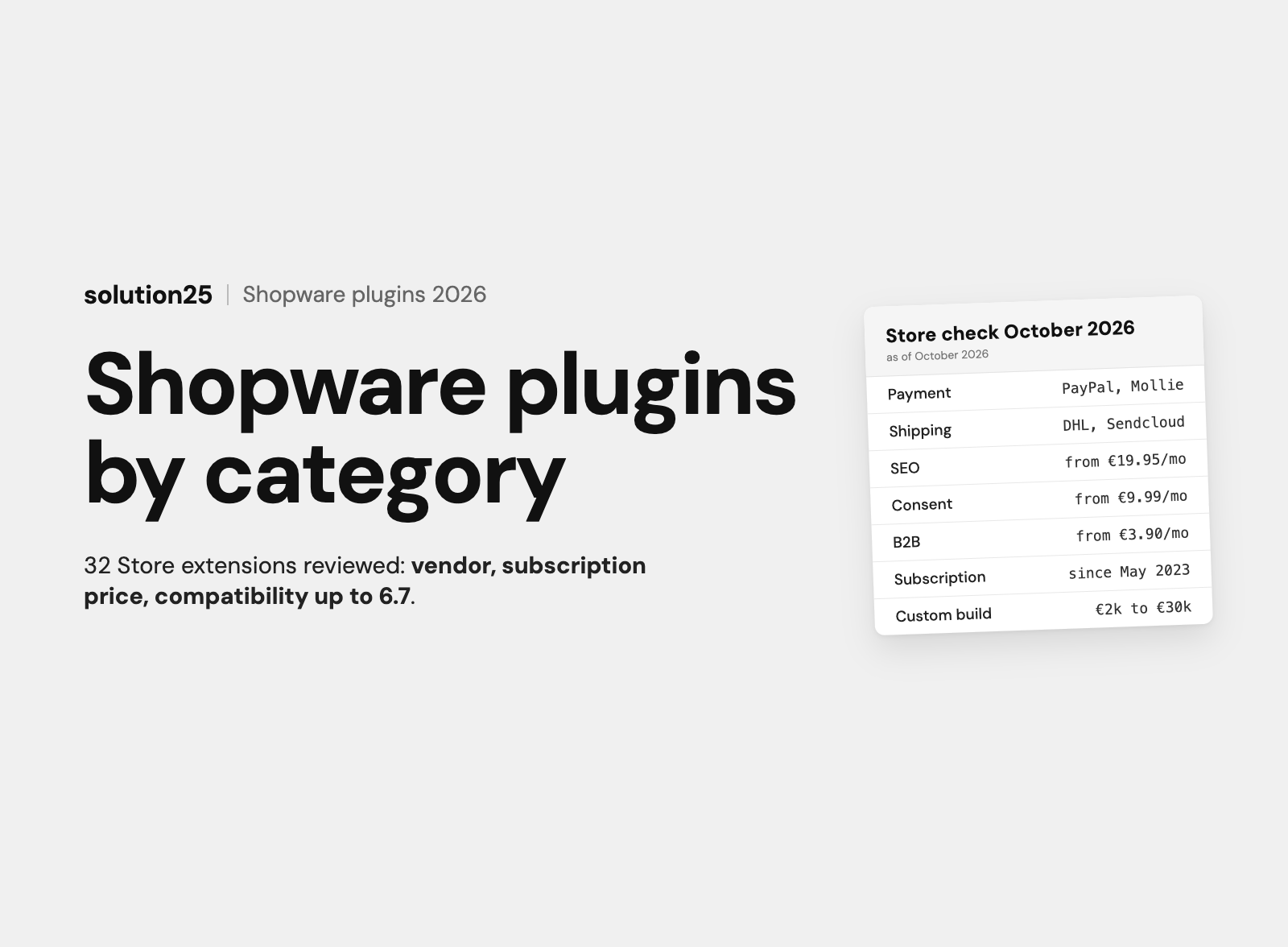
    Best Shopware 6 Plugins 2026: 32 Vetted Extensions with Pricing and Compatibility

    Shopware 6 Themes Title Image

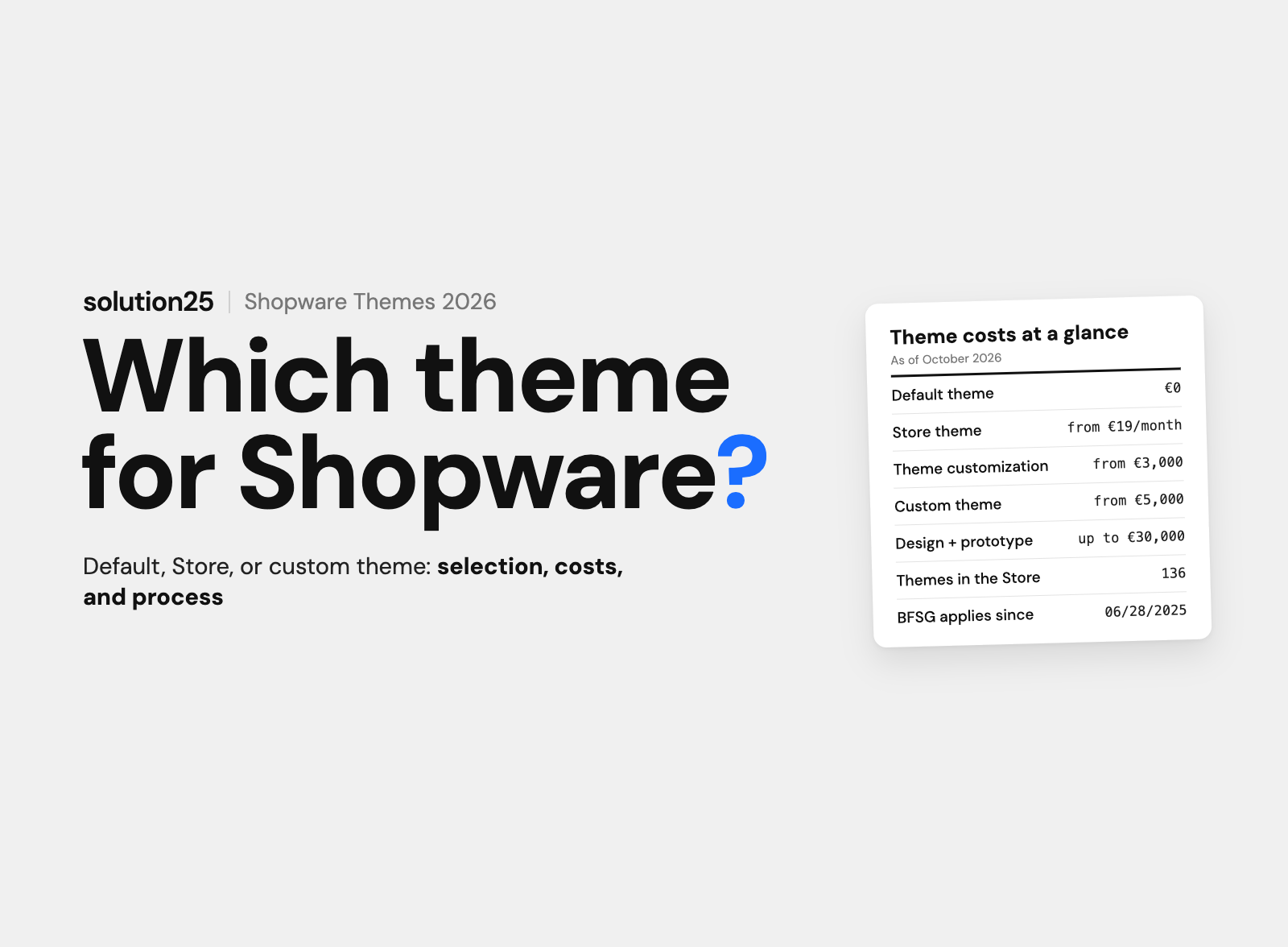
    Shopware Themes 2026: Choosing a Theme, Costs, and Custom Theme Development

    Shopware B2b Suite B2b Components Title Image

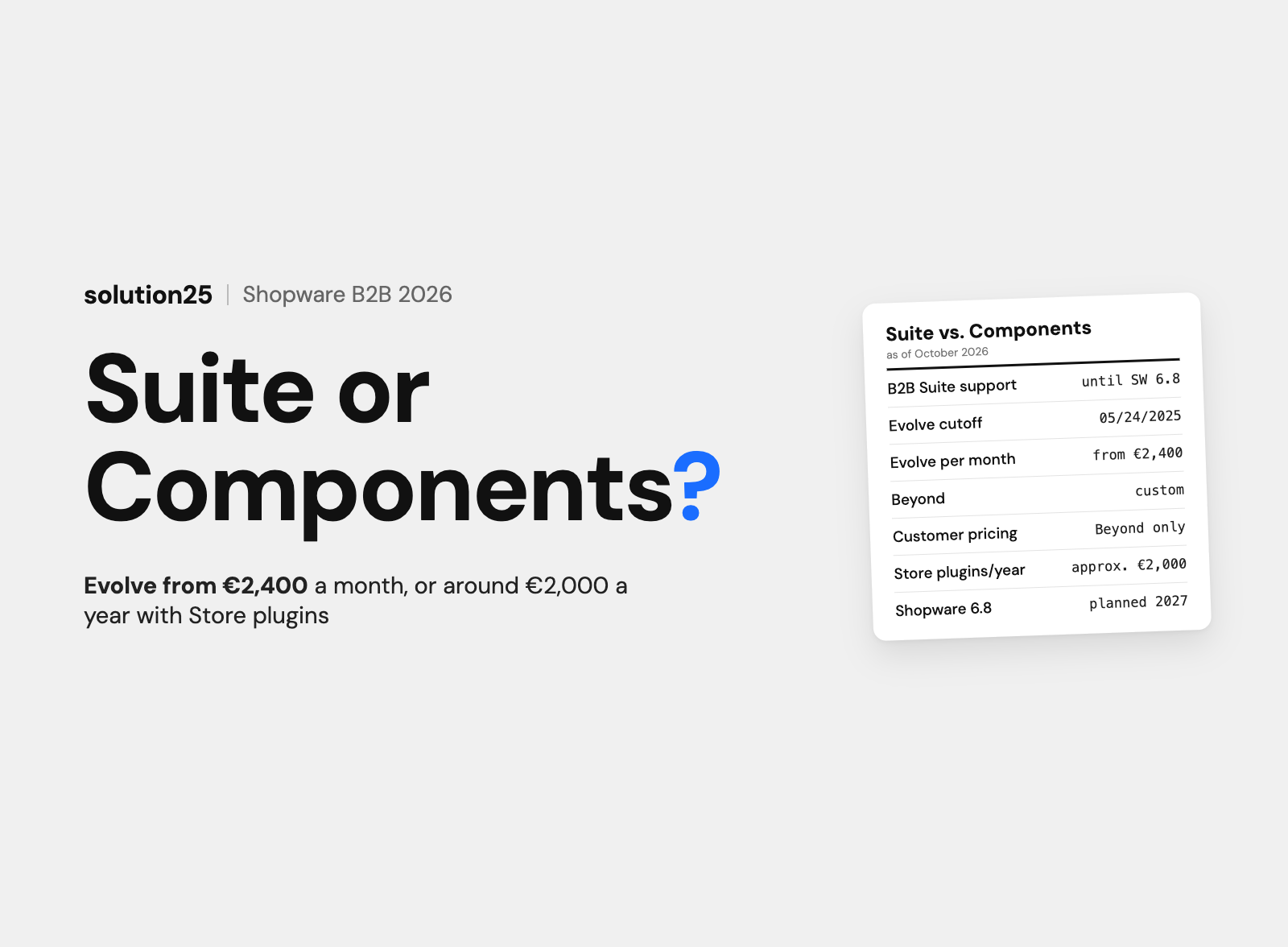
    Shopware B2B Suite or B2B Components? Features, Costs, and Migration in 2026

    Our drive.
    Your growth.

    The agency for e-commerce, software and AI.

    Get free advice
    Company
    • About Us
    • Events
    • Blog
    • Careers
    Events
    • Shopware
    • Shopify
    • Integrations
    • Migration
    Legal
    • Imprint & Legal Information
    • Privacy Policy
    • Shopware AI Data privacy
    Location
    New York 42nd St Suite 1201, New York, NY 10165 +1 929 264-7602 info@solution25.com
    Group 1321315536 1
    Group 1321315537 1

    © 2026 solution25. All rights reserved

    Linkedin Facebook Instagram