
What an AI chatbot in an online store can do today and what it costs: eight tools and four Shopware extensions with verified pricing, custom builds with Claude or OpenAI, metrics, common mistakes, and legal obligations.
An AI chatbot only takes pressure off customer service if it can access orders, shipments, and product data. Then it handles questions like “Where is my package?”, return requests, and product questions on its own and hands everything else to your team along with the conversation history.
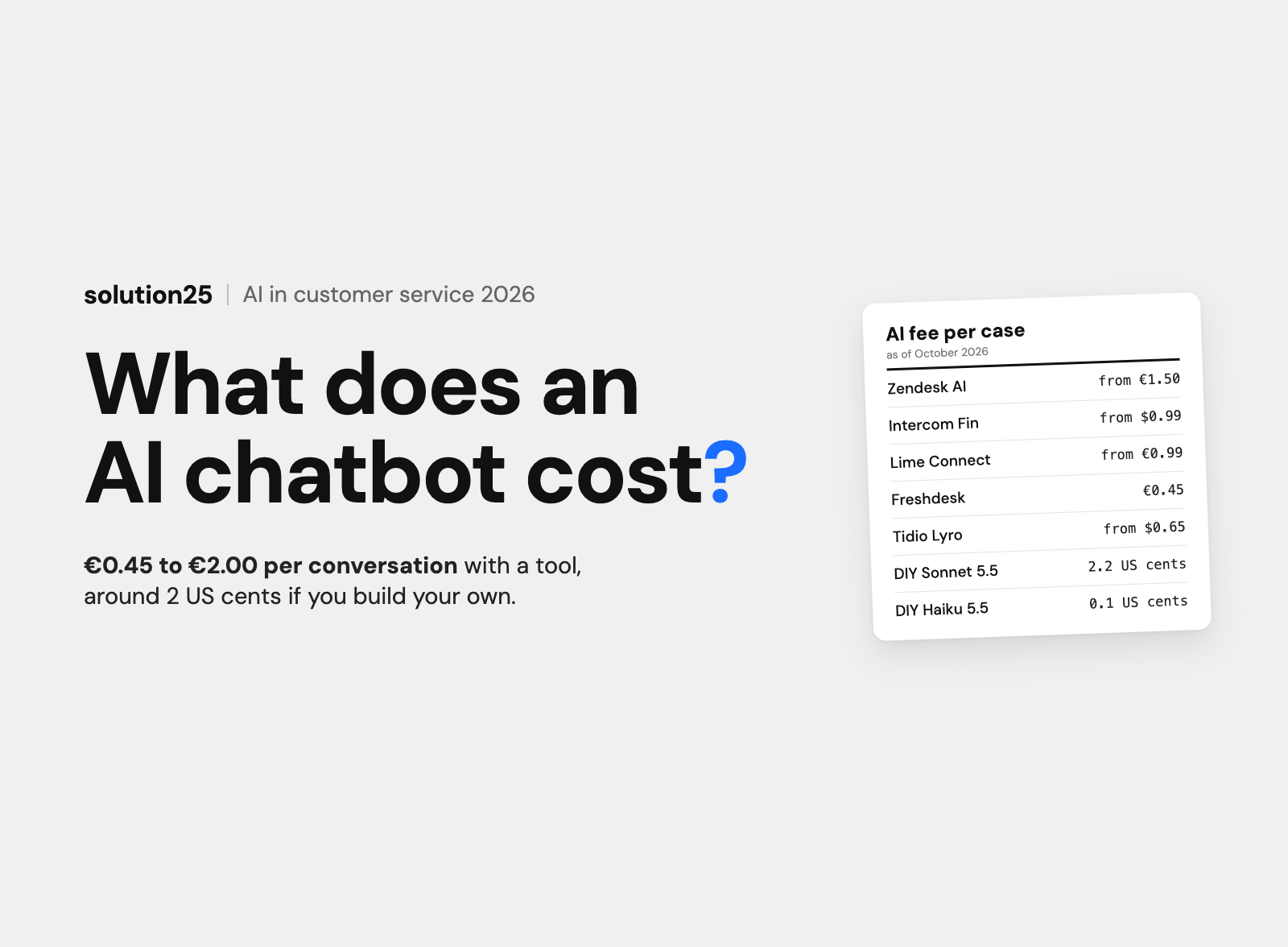
The costs come mainly from tool and resolution fees, hardly from the language model. Helpdesk vendors charge around €0.45 to €2.00 per conversation or resolved request, and flat-rate plans start at €750 per month. If you build your own, the model costs 0.1 to 11 US cents per conversation, plus setup at €3,000 to €15,000 (based on our experience).
Since August 2, 2026, customers must be able to tell that they are chatting with an AI. That’s required by Article 50 of the EU AI Act. Equally important are data processing agreements and a path to a human that is always open.
Before founding solution25, we ran our own online store with more than 500 orders a day and know the questions about delivery status and returns from our own inbox. Since 2017 we have been connecting Shopware to ERP systems, helpdesks, and shipping carriers, and now to language models as well.
A chatbot without access to orders and product data just shifts these requests around instead of taking work off the team. This article is for store owners and customer service leads with a Shopware store who want to choose an AI chatbot or have one built.
After reading it, you’ll be able to decide whether a Shopware extension, your helpdesk’s AI, or a custom build fits your request volume, and project the costs with your own numbers. All prices as of October 2026, excluding VAT, partly in US dollars for US vendors.
An AI chatbot is a conversational system that understands requests using a large language model (LLM) and answers them in natural language. The term chatbot combines “chat” and “bot”, short for robot.
Older chatbots work with decision trees and keywords. They recognize “delivery time”, show a prepared text, and fail at a message like: “I ordered on Monday and haven’t heard anything, will it arrive before my vacation?”
An AI chatbot understands that question, but it can only answer it with access to the order. That’s what decides whether a bot in an online store takes work off your plate or just politely stalls.
| Feature | Rule-based bot | AI chatbot without store data | AI chatbot with Shopware integration |
|---|---|---|---|
| Understands | Keywords and buttons | Natural language, typos, several questions in one message | Same as left, plus the context of the order |
| Answers from | Pre-written texts | FAQ, legal texts, product descriptions | Knowledge base plus live data from Shopware |
| “Where is my package?” | Link to package tracking | General information about delivery times | Status, tracking number, and delivery date of the specific order |
| Return | Link to the form | Explains the return policy | Checks deadline and item, creates the request or hands it off |
| Product advice | Fixed selection paths | Advises based on description texts | Advises with current price, stock, and delivery time |
| Main risk | Customers drop off | Made-up answers about deadlines and delivery times | Overly broad access rights |
As soon as a chatbot uses tools, meaning it looks up orders or creates a return, it is technically a simple AI agent. More on that in our article on AI agents in ecommerce.
According to Bitkom, customer contact is the most common use of AI: 72% of companies that use AI apply it there (603 companies with 20 or more employees, September 14, 2026).
The delivery status question can be answered almost entirely from Shopware data. The bot finds the order via the customer account or via order number and email address, reads the order, payment, and shipping status, and replies with the tracking link. If the promised delivery date has passed or there hasn’t been a scan for days, a staff member takes over with all the data.
For returns, the bot checks whether the deadline from your return policy is still open. Then it creates the request in your returns process, whether in Shopware, your ERP, or a returns portal. Goodwill cases and complaints belong with a human; the bot collects order number, item, a description of the defect, and photos up front.
Before purchase, an AI chatbot answers questions about sizes, materials, compatibility, and variants. With access to Shopware’s Store API, it gives the current price, availability, and delivery time instead of inferring them from old texts.
That helps conversion but doesn’t replace a good product page; see our guide to conversion optimization for online stores. Abandoned carts are covered by the abandoned cart analysis in Shopware.
For the skincare brand Saltedbeauty, we migrated the store to Shopware 6 with zero downtime, built filters by ingredients, applications, and skin needs, and connected a chatbot that makes personalized product suggestions. According to the case study, the recommendation feature increased the relevance of suggestions, and customer service uses the chatbot’s conversation logs to improve answers and follow up better.
For merchants, this means: an advisory chatbot needs the same well-maintained product attributes as good filters, and its logs show where answers don’t fit yet.
The prerequisite for all three tasks is read access to current order, shipping, and product data, plus well-maintained return and shipping rules. The limits are goodwill decisions, complaints, payment problems, and anything with legal effect: the bot hands these cases to your team with the conversation history.
Customers accept AI in customer service as long as they don’t hit a closed door. Studies and the best-known real-world example show this:
That leads to a clear division of labor: the bot handles standard cases completely, and everything else goes to humans with the history, so nobody has to ask their question twice.
Check these points before every demo, because vendors’ interfaces look more alike than their integrations do.
The bot hands off when the customer asks, when it twice fails to find a fitting answer, and for defined topics like complaints or payment problems. The handoff includes the history, order number, and a short summary. Outside service hours, a ticket is created with an honest response time.
You need a data processing agreement under Article 28 GDPR with every tool and model provider. According to their own statements, moinAI stores data only on German servers, and Lime Connect (formerly Userlike) uses European servers certified to the ISO 27001 security standard.
If you build your own, OpenAI processes API requests in Europe without storage on request, and Anthropic in Europe via Amazon Bedrock and Google Cloud Vertex AI (compliance page).
This overview comes from the vendors’ pricing pages, accessed October 28, 2026. Billing varies widely: per resolution, per session, per conversation, or flat rate.
| Vendor | Entry price per pricing page | AI billing | Note for Shopware merchants |
|---|---|---|---|
| Zendesk AI | Suite Team €55 per agent per month (annual), €69 monthly | 5 automated resolutions per agent included, each additional one €1.50 (committed) or €2.00 (pay as you go) | Order data via a custom script with an API call |
| Intercom Fin | From $0.99 per outcome, also on your existing helpdesk (minimum 50 outcomes per month) | One outcome per conversation, such as a resolution with no follow-up question; a handoff without an outcome is free | Data Connectors query external HTTPS APIs |
| Freshdesk (Freddy AI Agent) | Growth €17 per agent per month (annual) | 500 one-time sessions for new customers, then €45 per 100 sessions; one session covers 24 hours | Store extension embeds the widget and contact form |
| Lime Connect (formerly Userlike) | Pro from €87 per month (annual), at least 3 user seats | Connect AI Agent from €99 per month with 100 conversations | European servers, 10 WhatsApp numbers on the Pro plan |
| moinAI | Business €750 per month (annual), €880 monthly, minimum term 3 months | Unlimited conversations, packages by scope | German servers, WhatsApp on request |
| Parloa | On request | Usage-based: chat per interaction, phone per minute | Large service centers, phone and chat |
| Tidio (Lyro) | Lyro from $32.50 per month for 50 conversations | Tiered by conversations, the first 50 free one time | Native actions for Shopify, Shopware not listed |
| Gorgias | By ticket volume (50 to 5,000 tickets per month), not per agent | AI agent only costs money when it resolves a conversation | Integrations for Shopify, BigCommerce, Magento, and WooCommerce, not Shopware |
Most vendors bill per resolution or conversation, so costs rise with volume. With Zendesk and Intercom, you build the connection to Shopware orders yourself; ready-made store integrations exist mainly for Shopify.
Four extensions in the Shopware Store are aimed directly at AI customer service in the storefront:
| Extension (vendor) | Net price | Access to orders | AI provider |
|---|---|---|---|
| All-in-One AI Shop Assistant (Biloba IT) | €39.99 per month or €399 per year, Premium add-on €29.99 per month | With Premium: order, payment, and shipping status; guests with order number and email | Your own account with OpenAI, Google, Anthropic, or Mistral |
| AI Chatbot / Product Advisor (Kuhlware) | €80 per month or €940 per year | Logged-in customers only see their own orders, can be disabled per sales channel | OpenAI optional, without a key only with store data |
| NextGen OpenAI Chatbot (5 Elements Websolutions) | €79 per month or €800 per year | Product search with live data, order status not described | Your own OpenAI key |
| Microsoft AI Copilot Studio (elio) | Free, Copilot Studio license required | Help with orders, scope not described | Microsoft Copilot |
According to the Store, all four run on Shopware 6.7.15.1. With Biloba and 5 Elements, you pay the model costs through your own account; with Kuhlware, only in AI mode. So far only Biloba IT has ratings (4.97 out of 5 stars, 17 reviews).
A custom chatbot consists of just a few building blocks. The effort isn’t in the model but in clean tools, permissions, and the handoff.
Since version 6.7.11.0, Shopware ships its own MCP server in the core, and since 6.7.14.0 without a feature flag, meaning without separate activation. Through the /api/_mcp endpoint, Claude, ChatGPT, and other clients connect with an integration’s credentials, meaning a technical access account in Shopware; the Admin API permissions still apply. Until Shopware 6.8, the server is considered experimental.
For a chatbot that customers write to, however, admin access is too powerful. That’s why we use an intermediate layer that verifies identity and only passes the model the fields it needs. The Store API does have its own MCP endpoint (/store-api/_mcp), but in the core it only offers a tool for the sales channel context; more come through extensions.
For internal assistants in the service team, on the other hand, the MCP server is a good fit, for example for “Which returns came in today?”. Our article on the MCP Server for Shopware covers setup and permissions. With our plugin AI Connect, write actions only run after preview and confirmation, and every connection is limited to a Shopware role.
For product search in the storefront, AI Connect includes natural language search in which rate limits and reused answers keep unnecessary AI requests down. Our pages on Shopware GPT integration and the Shopware AI integration platform describe further building blocks.
Suppose your store has 1,000 conversations a month through the bot, it resolves 500 of them without staff, and three people work in customer service. Running costs at list price, excluding setup:
| Option | Calculation | Per month |
|---|---|---|
| Zendesk Suite Team | 3 × €55 plus 485 resolutions × €1.50 (15 included) | around €893 |
| Intercom Fin on your existing helpdesk | 500 outcomes × $0.99 | around $495 plus helpdesk |
| Freshdesk Growth | 3 × €17 plus 1,000 sessions × €0.45 | around €501 |
| moinAI Business | Flat rate with annual billing | €750 |
| Shopware extension | €80 plus model costs | €80 plus $1 to $22 |
| Custom build | Model costs only, excluding operations | $1 to $22 |
The model costs are based on 8,000 input and 600 output tokens per conversation (system prompt, rules, order data, three to four messages). According to the price lists from Anthropic and OpenAI, a conversation with Claude Haiku 5.5 or gpt-6-luna ($0.10 per million input tokens, $0.50 per million output tokens) costs around 0.1 cents. With Claude Sonnet 5.5 or gpt-6.1-sol ($2 and $10) it’s 2.2 cents, and with Claude Fable 5.1 or gpt-6-astra ($10 and $50) 11 cents.
At low volume, an off-the-shelf tool is cheaper because there’s no development. As volume grows, the math flips, because every resolution costs euros with a tool and cents with a custom build.
Ongoing costs include maintaining the knowledge base, spot checks, and model changes. Our overview of Shopware pricing shows how this fits into a store’s overall budget.
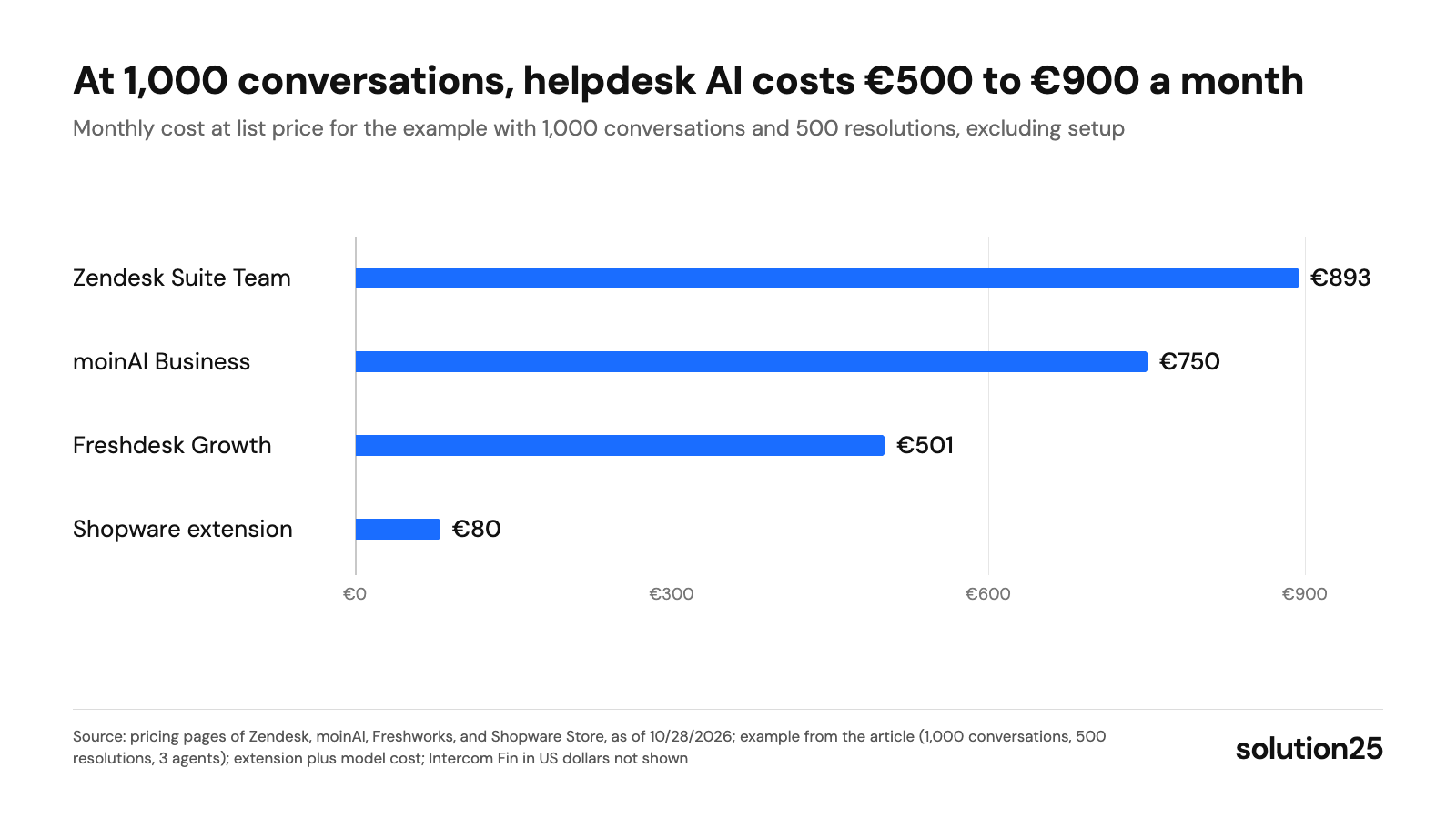
Figure: The chart shows that at 1,000 conversations per month, helpdesk AI costs several times as much as a Shopware extension, which is why merchants without a helpdesk start more cheaply with an extension. Source: pricing pages of Zendesk, moinAI, Freshworks, and the Shopware Store, as of October 28, 2026; example calculation from the article (1,000 conversations, 500 resolutions, 3 agents); extension plus model costs; Intercom Fin in US dollars not shown
A bot only takes pressure off if less work reaches the team and satisfaction holds. The numbers come from your helpdesk’s or chat tool’s reporting, or the conversation log if you built your own, plus a short rating at the end of the chat. Track these metrics:
Check the figures weekly for the first four weeks, then monthly. Adjust course if repeat contacts are above the pre-launch level, satisfaction with the bot drops, or the spot check reveals a serious error; check data access and the knowledge source first, then the model.
The following notes do not replace legal advice.
Under Article 50(1) of the AI Regulation (EU) 2024/1689, AI systems that interact directly with people must be designed so that users are informed they are interacting with an AI. Exceptions are cases where this is obvious. The notice must be clearly recognizable at the latest at the first interaction, and the obligation has applied since August 2, 2026.
The obligation is addressed to the providers of the system. If you develop the bot yourself or have it developed and put it into service under your own name, you are the provider. If you use a tool, check that the notice stays active.
Violations can be fined up to €15 million or 3% of worldwide annual revenue, and for small and medium-sized businesses the lower amount applies.
Besides the data processing agreements, you need a section on the chat in your privacy policy and fixed retention periods for conversation logs. For each request, only pass on the data the bot needs to answer.
On WhatsApp, AI providers have not been allowed to offer general-purpose assistants since January 15, 2026; according to Meta, this doesn’t affect businesses’ customer service bots (TechCrunch). According to the Business Solution Terms, your service providers may not use WhatsApp data to train AI models.
Air Canada’s chatbot told a customer he could apply for a bereavement fare retroactively within 90 days. According to Manatt, the Civil Resolution Tribunal in British Columbia ordered the airline to pay a refund in 2024 and rejected the argument that the chatbot was responsible for its own statements.
This isn’t a precedent for German courts. Still, plan as if the bot’s promises will be attributed to you.
your team works without a helpdesk, most questions concern products, shipping, and order status, and the store sells in one or two languages. Getting started costs €40 to €80 per month plus model costs.
your team already works in Zendesk, Freshdesk, Intercom, or a similar system and requests come in via email, chat, and WhatsApp. Project the per-resolution fees with your volume before you sign.
you have a high volume of requests, need to map your own returns or ERP processes, or want to control exactly where data is processed. Model costs in the cent range are then an advantage, but you carry development and operations yourself.
Our take: Without a helpdesk, a Shopware extension with order access is the most cost-effective start, because it runs with order access from around €70 per month and model costs are in the cent range. If you already work with Zendesk, Freshdesk, or Intercom, use its AI agent instead of introducing a second system. We only recommend a custom build at several thousand conversations per month or with your own returns and ERP processes.
An AI chatbot is a conversational system that understands questions using a large language model and answers them in natural language. Typical examples in an online store are delivery status inquiries, return requests, and product advice. It only becomes useful once it is allowed to access orders, shipments, and product data.
There is no single best one. Without a helpdesk, a Store extension with order access is the fastest start; with a helpdesk, its AI agent; and at high volume, a custom build. What matters is access to order data, handoff to humans, hosting, and the price per resolution.
ChatGPT and Claude have free versions, but without access to your store. For customer service there are only introductory offers, such as 50 free Lyro conversations one time at Tidio. In ongoing operation, the tool or model always costs money.
Shopware extensions cost €40 to €80 per month plus model costs of a few cents per conversation. Helpdesk AI costs around €500 to €900 per month in the example with 1,000 conversations. On top of that comes setup at €3,000 to €15,000 (based on our experience).
Yes. Since August 2, 2026, Article 50 of the EU AI Act requires that customers learn at the latest at the first interaction that they are chatting with an AI, unless that is obvious. The simplest approach is a notice in the chat widget and in the first message.
Yes, via the WhatsApp Business Platform, which Intercom and Lime Connect, for example, integrate with. Free-form replies are only possible within 24 hours of a customer message. Since October 1, 2026, 1,000 service messages per phone number per month are free, and after that Meta charges for each message.
Yes, if data processing agreements are in place, only necessary data is shared, and retention periods are defined. Several vendors process data in Germany or Europe. Your data protection officer handles the case-by-case review.
Want to know which requests an AI chatbot can handle in your store and what that costs at your volume? Get in touch. We’ll analyze typical requests with you and recommend an extension, helpdesk AI, or a custom build, with a cost estimate for your volume.
Already running a store? Our free store audit shows you in a PDF within two business days where your store is losing revenue, with a prioritized list of issues and an action plan.

Besnik Bilalli is the founder and CEO of solution25, the Shopware agency from Bremen. Before founding the agency in 2017, he built his own online store and grew it to more than 500 orders a day. Since then he has been helping merchants with Shopware projects, from the first budget to ongoing operations. He’s happy to answer questions about this article personally: get in touch.
Responsible for content and updates: Besnik Bilalli. Last updated: October 2026. Next content review: January 2027.
