
Logo Dark
  • Ecommerce

    See where your store can improve.

    Get Your Free Audit
    Frame 1321315514

    Shopware

    Platinum Partner, now in the US

    More
    Shopware Core Concepts Arrow Up Right Who Uses Shopware? Arrow Up Right Become a Good Shopware Partner Arrow Up Right Shopware Hosting Arrow Up Right Shopware Pre Go-Live Checklist Arrow Up Right Why Shopware in 2025? Arrow Up Right B2B on Shopware Arrow Up Right B2C on Shopware Arrow Up Right Shopware Performance Arrow Up Right Shopware Paas on Platform.sh Arrow Up Right Shopware for the U.S Market Arrow Up Right Shopware Seo Guide Arrow Up Right
    Frame 1321315514 1

    Shopify

    Fast to launch, built to scale

    More
    What is Shopify? Arrow Up Right Who should use Shopify? Arrow Up Right What can you do with Shopify? Arrow Up Right How much does Shopify cost? Arrow Up Right How do you choose your Shopify theme? Arrow Up Right Can you connect Amazon to Shopify? Arrow Up Right Who Owns Shopify? Arrow Up Right Shopify Disadvantages Arrow Up Right Benefits of Shopify Arrow Up Right
    Frame 1321315514 19

    Magento

    Complex catalogs and B2B

    Coming soon
    Frame 1321315514 18

    WooCommerce

    Flexible commerce for growing businesses

    Coming soon
    Frame 1321315514 2

    Migrations

    Move platforms without disrupting revenue

    More
    Shopware 5 to Shopware 6 Arrow Up Right Shopify to Shopware 6 Arrow Up Right Magento to Shopware 6 Arrow Up Right Oxid to Shopware 6 Arrow Up Right Migrations Arrow Up Right Prep for Shopware Platform Migrations Arrow Up Right Our Shopware Process Arrow Up Right Painful Shopware 6 Migrations if Done Wrong Arrow Up Right Shopware Prep: Historical Order Data Arrow Up Right Shopware Data Ready Arrow Up Right Shopware Content Migrations Arrow Up Right SEO Considerations in Platform Migrations Arrow Up Right
    Frame 1321315514 3

    Integrations

    Payments, tax, fulfillment, marketing

    More
    Shopware 5 Optimizely Campaign Arrow Up Right Shopware 6 Optimizely Campaign Arrow Up Right Shopware 6 PayTrace Payment Arrow Up Right Shopware 6 NMI Payment Arrow Up Right Shopware 6 MaxMind Fraud Prevention Arrow Up Right Shopware 6 Quotes & Customer-Specific Pricing Arrow Up Right Shopware 6 Subscription Arrow Up Right Shopware 6 Listrak Arrow Up Right Shopware 6 Multi Channel Arrow Up Right Shopware 6 Partial Delivery Arrow Up Right Shopware 6 AgeChecker.net Arrow Up Right Shopware 6 Pudo Point Arrow Up Right Why API First Opens Doors? Arrow Up Right Reduce the cost of ERP integrations Arrow Up Right PyPal Payment Provider Arrow Up Right Klaviyo Integration Guide for Shopware 6 Arrow Up Right Klaviyo - Email Marketing Integration Arrow Up Right Reviews.io Integration Guide for Shopware 6 Arrow Up Right Hubspot - Integration for Shopware 6 Arrow Up Right Mailchimp - Email Marketing Integration Arrow Up Right Google Analytics - Integration Guide Arrow Up Right Integrate Zapier with Shopware 6 Arrow Up Right Shopware 6 BlueSnap Arrow Up Right Shopware 6 Cybersource Arrow Up Right Shopware 6 Abandoned Cart Saver Arrow Up Right Shopware 6 Store Credit Arrow Up Right
    Frame 1618873659

    Start your Shopware migration with us.

    Learn more
    Shopware – Overview Shopware Core Concepts Arrow Up Right Who Uses Shopware? Arrow Up Right Become a Good Shopware Partner Arrow Up Right Shopware Hosting Arrow Up Right Shopware Pre Go-Live Checklist Arrow Up Right Why Shopware in 2025? Arrow Up Right B2B on Shopware Arrow Up Right B2C on Shopware Arrow Up Right Shopware Performance Arrow Up Right Shopware Paas on Platform.sh Arrow Up Right Shopware for the U.S Market Arrow Up Right Shopware Seo Guide Arrow Up Right
    Shopify – Overview What is Shopify? Arrow Up Right Who should use Shopify? Arrow Up Right What can you do with Shopify? Arrow Up Right How much does Shopify cost? Arrow Up Right How do you choose your Shopify theme? Arrow Up Right Can you connect Amazon to Shopify? Arrow Up Right Who Owns Shopify? Arrow Up Right Shopify Disadvantages Arrow Up Right Benefits of Shopify Arrow Up Right
    Migrations – Overview Shopware 5 to Shopware 6 Arrow Up Right Shopify to Shopware 6 Arrow Up Right Magento to Shopware 6 Arrow Up Right Oxid to Shopware 6 Arrow Up Right Migrations Arrow Up Right Prep for Shopware Platform Migrations Arrow Up Right Our Shopware Process Arrow Up Right Painful Shopware 6 Migrations if Done Wrong Arrow Up Right Shopware Prep: Historical Order Data Arrow Up Right Shopware Data Ready Arrow Up Right Shopware Content Migrations Arrow Up Right SEO Considerations in Platform Migrations Arrow Up Right
    Integrations – Overview Shopware 5 Optimizely Campaign Arrow Up Right Shopware 6 Optimizely Campaign Arrow Up Right Shopware 6 PayTrace Payment Arrow Up Right Shopware 6 NMI Payment Arrow Up Right Shopware 6 MaxMind Fraud Prevention Arrow Up Right Shopware 6 Quotes & Customer-Specific Pricing Arrow Up Right Shopware 6 Subscription Arrow Up Right Shopware 6 Listrak Arrow Up Right Shopware 6 Multi Channel Arrow Up Right Shopware 6 Partial Delivery Arrow Up Right Shopware 6 AgeChecker.net Arrow Up Right Shopware 6 Pudo Point Arrow Up Right Why API First Opens Doors? Arrow Up Right Reduce the cost of ERP integrations Arrow Up Right PyPal Payment Provider Arrow Up Right Klaviyo Integration Guide for Shopware 6 Arrow Up Right Klaviyo - Email Marketing Integration Arrow Up Right Reviews.io Integration Guide for Shopware 6 Arrow Up Right Hubspot - Integration for Shopware 6 Arrow Up Right Mailchimp - Email Marketing Integration Arrow Up Right Google Analytics - Integration Guide Arrow Up Right Integrate Zapier with Shopware 6 Arrow Up Right Shopware 6 BlueSnap Arrow Up Right Shopware 6 Cybersource Arrow Up Right Shopware 6 Abandoned Cart Saver Arrow Up Right Shopware 6 Store Credit Arrow Up Right
  • Software & AI

    See where your store can improve.

    Get Your Free Audit
    Frame 1321315514 4

    Software Development

    Platforms and portals, systems connected

    Coming soon
    Frame 1321315514 5

    App Development

    Web and mobile apps, API-first

    Coming soon
    Frame 1321315514 6

    AI Development

    Models connected, data enriched, assistants

    Coming soon
    Frame 1321315514 7

    Replatforming

    Switch platforms without losing revenue

    More
    Frame 1321315514 8

    All Integrations

    Payments, tax, fulfillment, marketing

    More
    Frame 1618873659 1

    Discover our latest Shopware plugin. MCP Connector.

    Explore the plugin
  • Solutions

    See where your store can improve.

    Get Your Free Audit

    Further links

    Frame 1321315514 16 GitHub Arrow Up Right Frame 1321315514 17 Shopware Store Arrow Up Right
    Frame 1321315514 10

    Shopware Plugins

    Extensions built by our team

    More
    Frame 1321315514 11

    Optimizely Integrationen

    Campaigns, automation and customer engagement

    More
    Frame 1321315514 12

    Lavet

    Migration and integration platform

    More
    Frame 1321315514 13

    StatHubs

    All store metrics in one dashboard

    Coming soon
    Frame 1321315514 21

    Pathway

    By Boldest, in partnership with solution25

    More
    Frame 1618873659 2

    Discover our Optimizely Campaign plugin.

    Explore the plugin
  • Company

    See where your store can improve.

    Get Your Free Audit

    About

    Events & Summit

    Resources

    Careers

    Frame 1618873659 3

    Built by people who know commerce.

    Chevron Right White
  • Blog
  • Contact
  • Language: EN

    Select Language

    • DE
    • EN
    • AT
    • CH
    • NL
    • UK
    • IT
+1 929-264-76 02
  • DE
  • AT
  • CH
  • NL
  • UK
  • IT
  • Free consultation
    1. Home /
    2. What Is Shopware? The E-Commerce Platform Explained
    What Is Shopware
    9 November 2026

    What Is Shopware? The E-Commerce Platform Explained

    Besnik Bilalli
    Besnik Bilalli, Founder and CEO of solution25Published November 9, 2026 · 8 min read

    What is Shopware? The German e-commerce platform explained in plain English: origins, architecture, features, editions and 2026 pricing, and which businesses it suits.

    The short answer

    Shopware is an e-commerce platform from Germany that retailers and manufacturers use to run online stores for consumers (B2C) and business customers (B2B). The current generation is Shopware 6. Its core is open source under the MIT license and built on PHP with the Symfony framework.

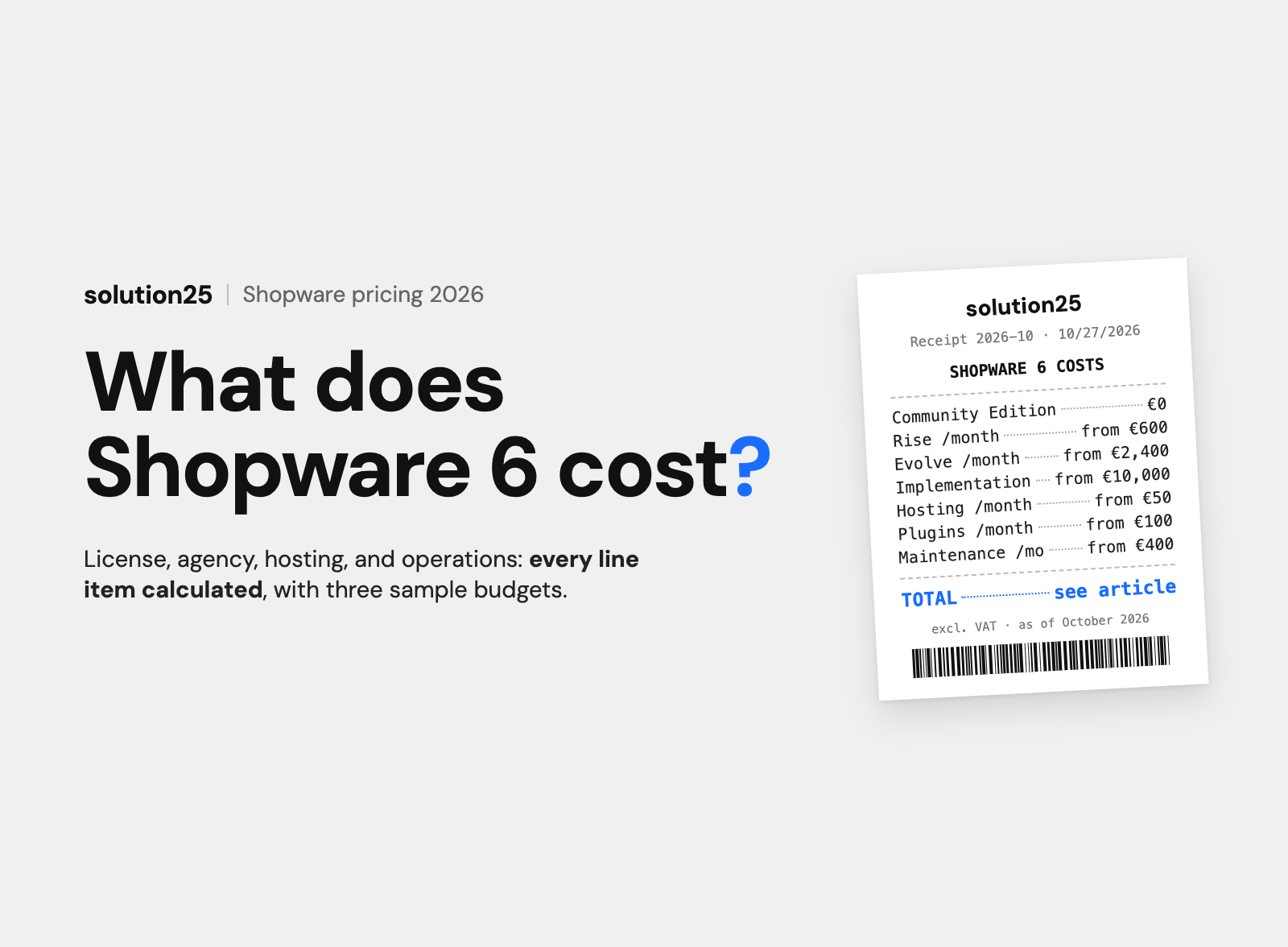
    The software is free, running a store is not. The Community Edition has no license fee. The paid plans Rise, Evolve, and Beyond start at €600 per month and add features and direct support. On top of that come hosting, implementation, and extensions.

    Shopware is a particularly good fit for mid-sized retailers with their own processes, ERP integrations, and B2B requirements. For a small store with a standard catalog, a hosted platform is often the simpler route.

    Anyone comparing e-commerce platforms in Europe runs into Shopware sooner or later. This guide explains in plain English what’s behind the platform, what it can do out of the box, what it costs, and who it’s worth it for. It’s written for business owners, e-commerce managers, and anyone choosing a platform right now.

    Contents

    1. The short answer
    2. Where Shopware comes from
    3. How Shopware 6 is built
    4. What Shopware can do out of the box
    5. The editions: Community, Rise, Evolve, and Beyond
    6. Where your store runs: self-hosted, PaaS, or SaaS
    7. Who Shopware is right for, and who it isn't
    8. Shopware 5 and Shopware 6: what you need to know
    9. Shopware FAQ
    10. Shopware with solution25
    11. Further reading

    Where Shopware comes from

    Shopware comes from Schöppingen, a small town in northwest Germany. Brothers Stefan and Sebastian Hamann developed the software in the early 2000s, and shopware AG was founded in 2008. A free open source version has been available since 2010. In 2019, Shopware 6 followed as a completely rebuilt generation.

    In 2022, Carlyle and PayPal invested $100 million in Shopware. It was the company’s first outside funding, and the founders still hold the majority. According to Shopware, it became the market leader among Germany’s 1,000 highest-grossing online stores that same year, as measured by the EHI Top 1000 Shops study.

    What this means for you: Shopware is backed by an established company, a large developer community, and a dense network of partner agencies. The platform won’t disappear overnight, and you’ll find specialists if you ever want to switch providers.

    How Shopware 6 is built

    Shopware 6 has three parts that work together:

    • Administration: the browser-based back office where you manage products, categories, orders, customers, content, and settings.
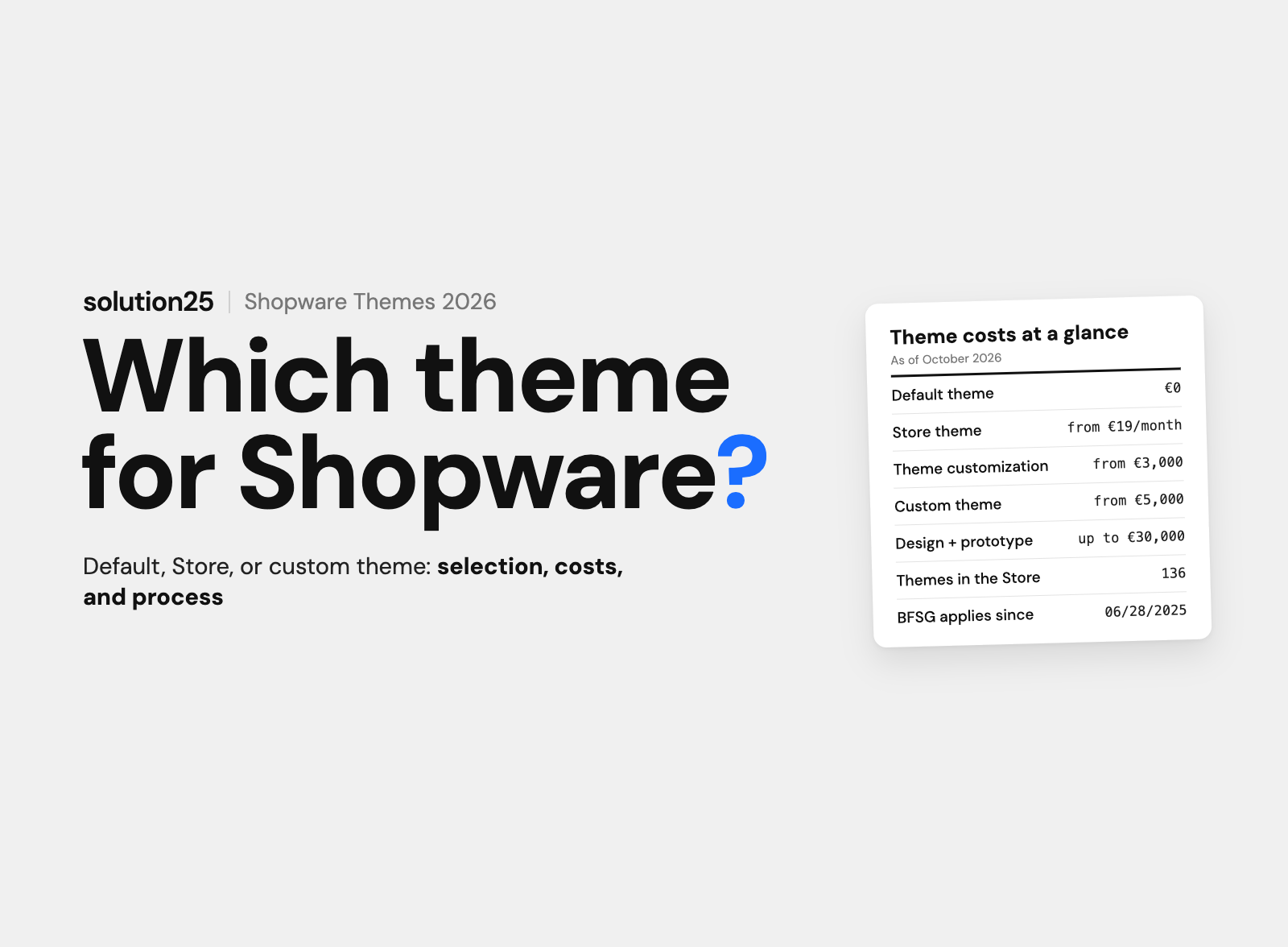
    • Storefront: the store your customers see. Themes control the design, and you can adapt them or have a custom one built.
    • API: interfaces that let your ERP, PIM, marketplaces, or your own app talk to the store. Shopware is built API-first, so you can also replace the storefront with your own frontend. That’s called headless commerce.

    Under the hood, Shopware runs on PHP with the Symfony framework and a MySQL or MariaDB database. The administration uses Vue.js. This is widely used standard technology with plenty of developers available, so you aren’t tied to a single provider.

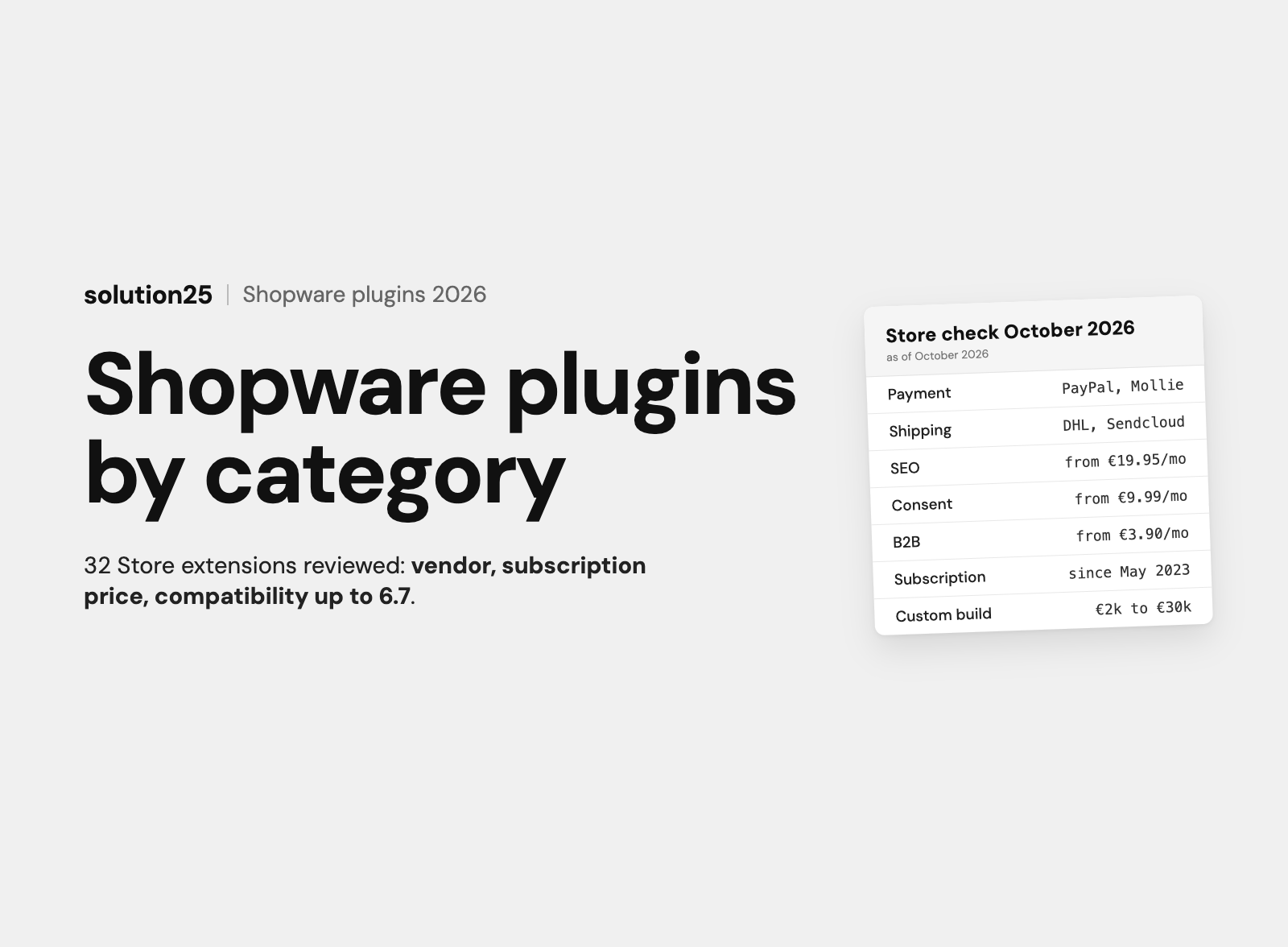
    Additional features come from extensions in the Shopware Store. Plugins run directly inside the system, while apps connect through APIs. Our guide to Shopware 6 plugins shows which extensions are worth it and how to avoid plugin chaos.

    What Shopware can do out of the box

    Even without extensions, Shopware 6 includes tools that other platforms need add-ons for. The most important ones:

    Feature What it does What you use it for
    Shopping Experiences Build pages from blocks with drag and drop: homepage, landing pages, category pages Manage content and campaigns without hiring a developer
    Rule Builder Combine conditions into rules, such as customer group, cart value, or shipping country Control prices, shipping costs, payment methods, and discounts precisely
    Flow Builder Automate processes: when an event happens, an action follows Trigger emails, tags, and status changes without coding
    Sales channels Run several stores with their own domains, languages, and currencies from one installation Operate country stores, brand stores, or a B2B portal next to your B2C store
    Products and variants Properties, variants, tiered pricing, cross-selling, digital products Handle large and complex catalogs
    Multiple languages Manage content, products, and emails in several languages Sell internationally without setting up a second system

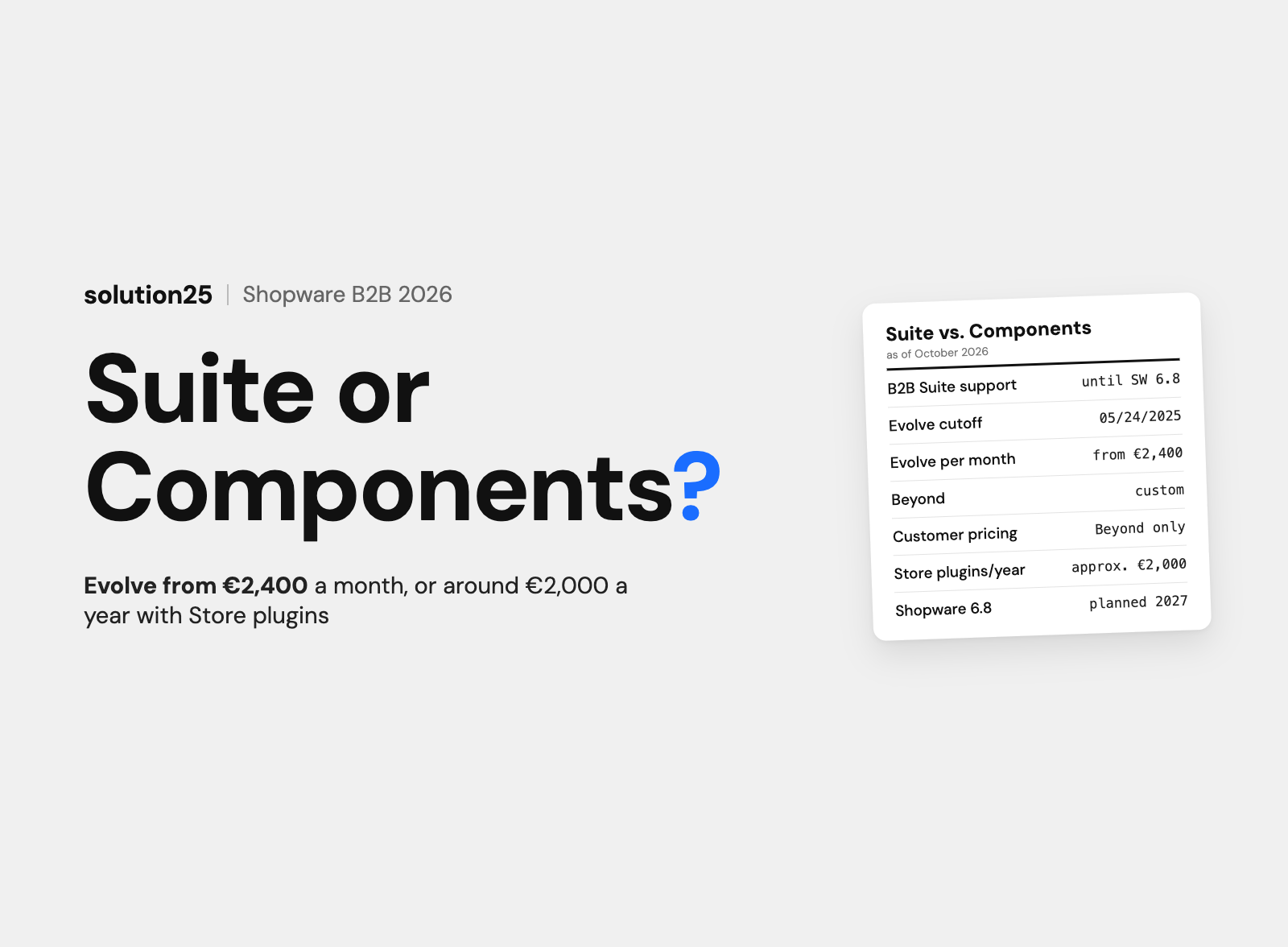
    For selling to business customers, the B2B Components add features such as quotes, purchase approvals, and employee accounts. They are included in plans from Evolve upward. Our article on the B2B Suite and B2B Components has the details. The paid plans also include AI features, for example for product descriptions. Our guide to Shopware AI covers what actually helps day to day.

    The editions: Community, Rise, Evolve, and Beyond

    Shopware offers four plans. All of them share the same core. Higher plans add features and support.

    Plan Price (excl. VAT) Best for
    Community Edition €0 Merchants who handle hosting and operations themselves; support through the community
    Rise from €600 per month Growing B2C stores, with AI content features, returns management, and direct support from Shopware
    Evolve from €2,400 per month B2B stores and larger B2C retailers, with B2B Components and phone support
    Beyond custom Companies with complex pricing and fulfillment, multiple warehouses, and 24/7 support

    One thing to know about the Community Edition: the software stays free. Access to your Shopware Account and the Shopware Store, however, requires that your stores generated less than €1 million in gross merchandise value (GMV) over the last 365 days. Above that, Shopware requires a paid plan. You can keep using the software itself.

    The license is rarely the biggest cost. Implementation, hosting, extensions, and support usually cost far more. All prices and three sample budgets for the first year are in our guide How much does Shopware 6 cost?.

    Where your store runs: self-hosted, PaaS, or SaaS

    You can run Shopware in three ways:

    • Self-hosted: Shopware runs on a server of your choice, with a hosting provider or in your own data center. You have full control and are responsible for updates, security, and performance.
    • PaaS: Shopware provides a managed cloud platform, and your team or agency deploys the code. Shopware takes care of the infrastructure.
    • SaaS: Shopware runs the entire store and installs updates itself. In return, deep changes to the code aren’t possible, and extensions run as apps.

    For stores with a lot of custom work, self-hosting with a specialized host is often the most flexible option. If you want as little technology in-house as possible, look at PaaS or SaaS. Our guide to Shopware hosting covers costs and what to look for in a host.

    Who Shopware is right for, and who it isn't

    Shopware isn’t a quick-start site builder. It’s a platform for merchants who want to grow and map their own processes.

    Shopware is a good fit if you

    • have a catalog with many variants, configurations, or customer-specific prices,
    • need to connect an ERP, PIM, or marketplaces,
    • sell to business customers or combine B2B and B2C,
    • serve several countries, languages, or brands from one system,
    • care about data ownership, hosting in a region of your choice, and open code.

    Another platform is often better if you

    • are starting with a handful of products and have no budget for an agency,
    • have no technical contact and want everything from a single provider,
    • mainly want to test quickly whether a product sells at all.

    In that case, a hosted platform like Shopify is usually the easier start. Our article Shopify vs. Shopware compares the two fairly. If you’re also looking at Magento or WooCommerce, read Shopware vs. Magento vs. WooCommerce.

    A note for US merchants: Shopware’s roots are in Germany, and most partner agencies are based in Europe. The platform supports US dollar pricing and English storefronts, and sales tax calculation is usually added through a tax service integration. Before you commit, make sure your agency has built stores for the US market and that its working hours overlap with yours.

    Shopware 5 and Shopware 6: what you need to know

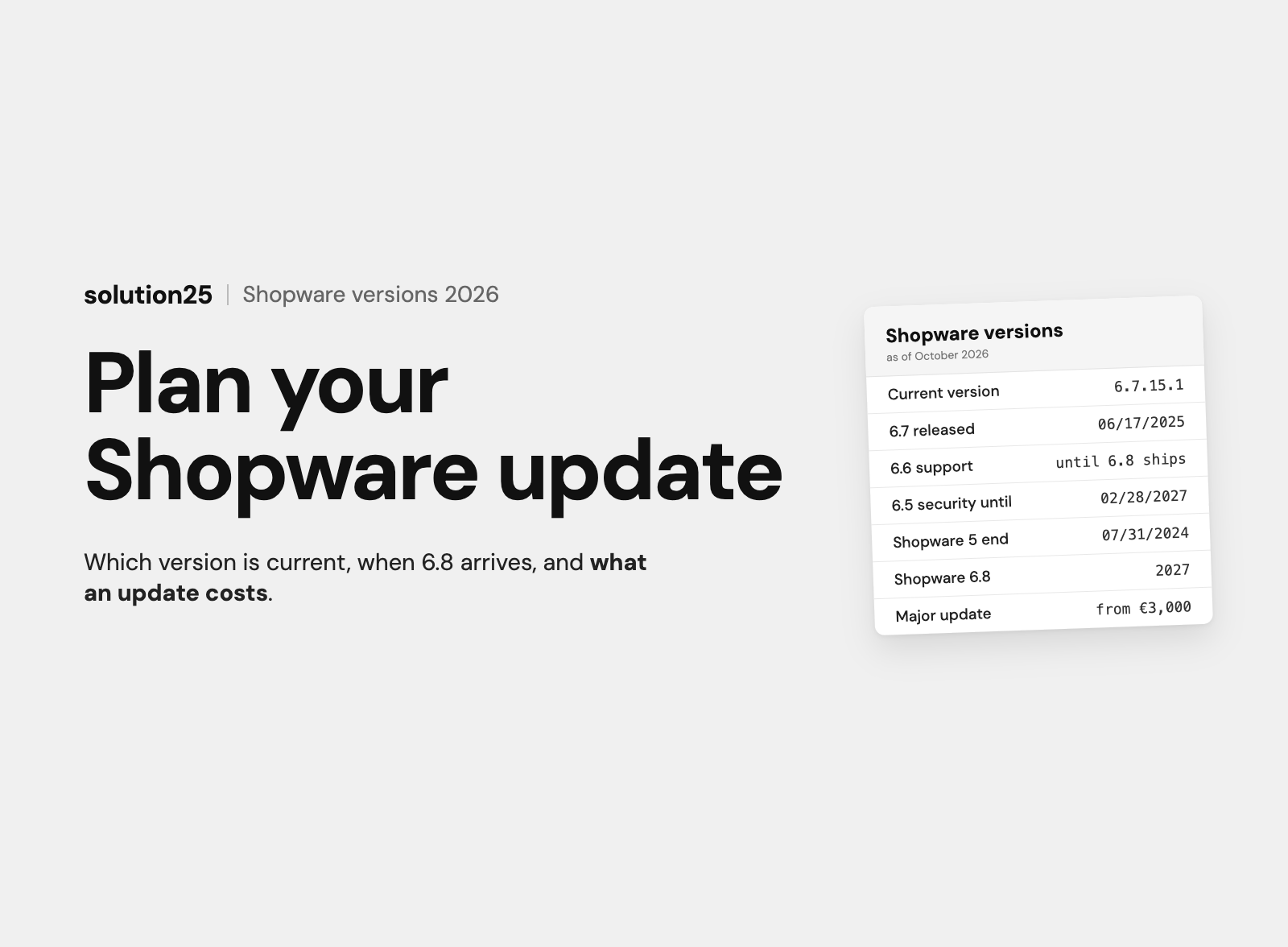
    When people talk about Shopware today, they mean Shopware 6. Shopware 5 reached end of life on July 31, 2024, and no longer receives security updates. The two versions aren’t technically compatible, so moving from 5 to 6 is a migration, not an update. Our guide to migrating from Shopware 5 to 6 explains how it works.

    The current major version is Shopware 6.7. The next major version, 6.8, is planned for 2027. We keep the version status up to date in our article on Shopware updates and versions.

    Shopware FAQ

    Is Shopware free?

    The Community Edition is free and open source. You pay for hosting, implementation, extensions, and support. Once your stores pass €1 million in gross merchandise value within 365 days, Shopware requires a paid plan for access to your account and the Store.

    Is Shopware open source?

    Yes. The core of Shopware 6 is released under the MIT license and publicly available on GitHub. You can use, modify, and extend it.

    What programming language is Shopware written in?

    PHP, based on the Symfony framework. The administration uses Vue.js, and the storefront uses the Twig template language.

    Is Shopware a good choice for small stores?

    Technically yes, economically not always. Shopware shines with integrations, B2B, and custom processes. A small store with a standard catalog often gets there cheaper and faster on a hosted platform.

    Do I need an agency for Shopware?

    Not necessarily. But setup, theme customization, integrations, and updates require developer skills, so most merchants work with an agency or a freelancer. Our guide How to find a Shopware agency shows how to choose.

    Shopware with solution25

    Wondering whether Shopware fits your project? As a Shopware Platinum Partner based in Bremen, Germany, we have delivered Shopware projects since 2017. Talk to us. We’ll tell you honestly whether Shopware is the right choice or whether another platform fits better.

    Already running a store? Our free shop audit shows where your technology, performance, and conversion stand today. Learn more about how we work on our Shopware agency page.

    Further reading

    • How much does Shopware 6 cost?: license, hosting, extensions, and three sample budgets for the first year.
    • Shopify vs. Shopware: which platform fits which store.
    • Shopware hosting: self-hosted, PaaS, or cloud, and what each option costs.
    • Shopware 6 plugins: which extensions are worth it.
    • How to find a Shopware agency: where to search and which twelve questions to ask.

    Sources

    • Shopware: plans and pricing, including the Community Edition fair usage policy, accessed November 2026
    • Shopware: company history, accessed November 2026
    • GitHub: Shopware 6 repository under the MIT license, accessed November 2026
    • Shopware: press release on the Shopware 6 Early Access version, July 30, 2019
    • TechCrunch: Shopware raises $100M from PayPal and Carlyle, February 8, 2022

    About the author

    Besnik Bilalli 234x300

    Besnik Bilalli is the founder and CEO of solution25, the Shopware agency from Bremen. Before founding the agency in 2017, he built his own online store and grew it to more than 500 orders a day. Since then he has been helping merchants with Shopware projects, from the first budget to ongoing operations. He’s happy to answer questions about this article personally: get in touch.

    Responsible for content and updates: Besnik Bilalli. Last updated: November 2026. Next content review: February 2027.

    Contents

    1. The short answer
    2. Where Shopware comes from
    3. How Shopware 6 is built
    4. What Shopware can do out of the box
    5. The editions: Community, Rise, Evolve, and Beyond
    6. Where your store runs: self-hosted, PaaS, or SaaS
    7. Who Shopware is right for, and who it isn't
    8. Shopware 5 and Shopware 6: what you need to know
    9. Shopware FAQ
    10. Shopware with solution25
    11. Further reading

    Latest Posts

    Shopware 6 Pricing 2026 Title Image

    Shopware Pricing 2026: What Shopware 6 Really Costs

    Shopware Update Versions Title Image

    Shopware Update and Versions 2026: 6.7, 6.8, Shopware 7, and a Safe Process

    Shopware 6 Plugins Title Image

    Best Shopware 6 Plugins 2026: 32 Vetted Extensions with Pricing and Compatibility

    Shopware 6 Themes Title Image

    Shopware Themes 2026: Choosing a Theme, Costs, and Custom Theme Development

    Shopware B2b Suite B2b Components Title Image

    Shopware B2B Suite or B2B Components? Features, Costs, and Migration in 2026

    Our drive.
    Your growth.

    The agency for e-commerce, software and AI.

    Get free advice
    Company
    • About Us
    • Events
    • Blog
    • Careers
    Events
    • Shopware
    • Shopify
    • Integrations
    • Migration
    Legal
    • Imprint & Legal Information
    • Privacy Policy
    • Shopware AI Data privacy
    Location
    New York 42nd St Suite 1201, New York, NY 10165 +1 929 264-7602 info@solution25.com
    Group 1321315536 1
    Group 1321315537 1

    © 2026 solution25. All rights reserved

    Linkedin Facebook Instagram